Find your city

Type your city or ZIP code to see the best-rated septic service companies near you.

Get free quotes

Septic Tank Services in Virginia

The best-rated septic service companies across Virginia, plus state laws, permits and costs.

Finding reliable septic tank services in Virginia starts with knowing who regulates the work and what it should cost. The Virginia Department of Health sets the statewide rules, while the Department of Professional and Occupational Regulation licenses the people doing the work. This page covers the main permit and licensing requirements, typical price ranges compared with national averages, and some of the highest-rated companies in the state.

37 cities70 companiesavg. 4.7★

Top 10 septic service companies in Virginia

Below are some of the best-rated septic companies in Virginia, with their cities and review counts. Ratings and review volumes help you compare providers, but always confirm a company's license and service area before booking.

Show map

Powell's Plumbing & Air

4.9 (1,254) Chesapeake, VA 24/7

Customers value fast responses, same-day scheduling, and technicians who explain options and test the system after a fix. Reviews describe a professional, courteous crew and fair pricing for both septic and general plumbing work.

  • Same-day service
  • Professional technicians
  • Fair pricing

Services:PumpingRepair

Contact See reviews Best in Chesapeake →

Cubbage Septic Solutions

4.9 (305) Harrisonburg, VA

Customers appreciate how quickly this team arrives and how well they handle urgent problems, including a failed pump that was fixed the next day. Reviewers also praise the crew's professionalism, honesty about what work is really needed, and clear explanations along the way.

  • Fast response
  • Honest advice
  • Alternative systems

Services:PumpingRepairServiceInspectionAerobic Septic System Service

Contact See reviews Best in Harrisonburg →

Harolds Septic Service

5.0 (61) Lynchburg, VA 24/7

Customers consistently value the owner's quick response, including same-day and weekend emergency visits, and his friendly, straightforward manner. Pricing is repeatedly described as reasonable, and reviewers appreciate that he explains the work without upselling.

  • Fast response
  • Fair pricing
  • Friendly service

Services:PumpingCleaningRiser InstallationServiceMaintenance

Contact See reviews Best in Lynchburg →

Asonja Septic & Pumping

5.0 (36) Hampton, VA 24/7

Customers appreciate the owner's willingness to walk them through inspections and repairs, and the company is praised for quick phone answers and accurate estimates. Reviewers also highlight punctual arrivals and round-the-clock availability for urgent septic and plumbing problems.

  • 24/7 availability
  • Clear explanations
  • Punctual arrivals

Services:PumpingInspectionRepairService

Contact See reviews Best in Hampton →

Virginia Septic Tank Laws & Requirements

Septic work in Virginia is governed by a layered set of state rules and agency responsibilities. Knowing which agency handles which step helps you avoid delays when building, upgrading or maintaining a system.

Who regulates it Virginia Department of Health (VDH), Division of Onsite Water and Wastewater Services, through local health districts. Contractor licensing is handled by the Department of Professional and Occupational Regulation (DPOR).

VDH sets the statewide septic rules (12VAC5-610 for conventional systems and 12VAC5-613 for alternative systems) and its local health districts issue the permits. DPOR licenses the soil evaluators, installers and operators, and homes in Chesapeake Bay Preservation Areas must have the septic tank pumped or inspected every 5 years.

1

Virginia Septic Tank Laws

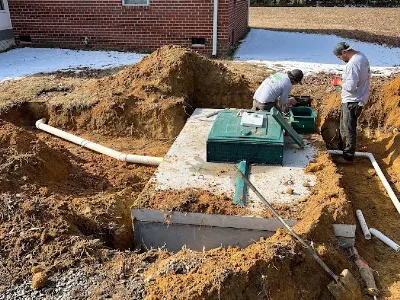
The Virginia Department of Health (VDH) sets the statewide septic rules through its Division of Onsite Water and Wastewater Services, working through local health districts. Conventional systems fall under 12VAC5-610 and alternative systems under 12VAC5-613. Property not served by public sewer needs a VDH permit to construct a sewage disposal system before a county building permit can be issued. Homes in Chesapeake Bay Preservation Areas must have their septic tank pumped or inspected at least once every 5 years.

2

Virginia Septic Tank Requirements

Anyone installing, expanding or modifying a septic system needs a VDH construction permit first. You apply through your local health district with supporting work from a DPOR-licensed private consultant. The construction permit is valid for 18 months. After installation, inspections and the installer's completion statement, VDH issues an operation permit. Existing systems must be certified by the health department as adequate before new construction, or upgraded under a construction permit.

3

Virginia Septic Code

The Virginia septic code is written in 12VAC5-610 for conventional systems and 12VAC5-613 for alternative systems, and minimum separation distances for tanks and drainfields are set in its site limitation provisions. Some localities require larger reserve drainfield areas than the state minimum, so check with your health district before planning a site. Under the Code of Virginia, only licensed onsite soil evaluators may submit private site evaluations for permit applications.

Key rules at a glance (10), with official sources
TopicRuleSource
Who regulatesDEQ states that VDH's Division of Onsite Water and Wastewater Services generally oversees applications, construction, maintenance and pump-and-haul requirements for septic tanks.deq.virginia.gov
Permit before buildingProperty not served by public sewer or a public water system needs a VDH permit to construct a sewage disposal system or private well before the county will issue a building permit.vdh.virginia.gov
Existing systemsIf a property already has a septic system, the owner must get a health department certification that it is adequate for the proposed construction, or get a construction permit to upgrade it.vdh.virginia.gov
Permit validity and operation permitVDH's application package says to apply for a construction permit (valid 18 months) only when ready to build, and after installation, inspections and the installer's completion statement the health department issues an Operations Permit.vdh.virginia.gov
Who can do the site evaluationBy Virginia law, VDH accepts private evaluations for septic permit applications only from licensed onsite soil evaluators, and no system may be built or modified without a VDH permit.law.lis.virginia.gov
Pumping and maintenanceIn Chesapeake Bay Preservation Areas, septic tanks must be pumped out or inspected at least once every 5 years (9VAC25-830-130), and outside those areas pumping is not required by law but is recommended every 3 to 5 years.deq.virginia.gov
VDH pump-out enforcement pilotSince July 1, 2023, VDH (not local governments) enforces the Bay pump-out requirement in the Three Rivers and Eastern Shore health districts, and maintenance providers there must report pump-outs through a VDH web portal.vdh.virginia.gov
Inspection at saleVirginia REALTORS and the VOWRA FAQ both say the 2025 law (HB 2671, effective July 1, 2025) does not require a septic inspection for a residential sale, but any inspection requested by a lender, buyer or other party as a condition of sale or refinancing must meet minimum state standards. Some commercial websites claim a mandatory inspection at every sale, which these sources contradict.virginiarealtors.org
SetbacksMinimum separation distances for septic tanks and drainfields are set in 12VAC5-610 (Table 4.4 in 12VAC5-610-930, plus Part IV site limitations), and I could not retrieve the exact official distances, so check that table or your health district. Virginia Tech Extension says some localities also require a 100% or even 200% reserve drainfield area where the state minimum is 50% for silty and clayey soils.pubs.ext.vt.edu
Alternative discharging systemsFor a single-family home discharging under 1,000 gallons per day, VDH issues the permit jointly with DEQ, and VDH reviews the designs and conducts annual inspections of each discharging system. Anything else discharging under 1,000 gallons per day is permitted solely by DEQ.vdh.virginia.gov

Official sources:VDH Southside Health District - Onsite Program (Well and Septic)VDH Permits to Construct a Sewage Disposal System and/or Private Well (application package)Code of Virginia Title 32.1, Chapter 6 - Environmental Health ServicesCode of Virginia Title 32.1, Chapter 6, Article 1 - Sewage Disposal12VAC5-610 Part IV Site Limitations (Virginia Administrative Code)VDH Three Rivers Health District - Septic Pump Out Information

Rules change and some counties add their own. Check with your county health department before you start work.

Septic Tank permits and licenses in Virginia

A VDH construction permit is required before any septic system is installed, expanded or modified, and it must be in hand before the county issues a building permit. You apply to your local health district with a site evaluation prepared by a DPOR-licensed soil evaluator. The construction permit is valid for 18 months, and once work is inspected and the installer signs a completion statement, VDH issues an operation permit. Permit and repair fees vary by health district, so confirm current amounts directly with your local office before scheduling work.

How much does septic tank pumping cost in Virginia?

In Virginia, septic tank pumping typically ranges from $295 to $570, with an average near $435, which is almost identical to the national range of $290 to $565. Septic tank installation averages about $7,585 in Virginia, between $3,540 and $12,130, compared with a national average near $7,500. Drain field services are the largest expense, averaging around $8,090 statewide. Routine inspections usually cost about $555 on average, slightly above the national figure of $550, so Virginia prices track national norms closely.

ServiceIn VirginiaNational
Septic Tank Pumping Cost $295 – $570 $290 – $565 +1%
Septic Tank Installation Cost $3,540 – $12,130 $3,500 – $12,000 +1%
Septic Tank Maintenance $305 – $505 $300 – $500 +1%
Septic Tank Inspection $200 – $910 $200 – $900 +1%
Septic Tank Replacement Cost $3,035 – $10,110 $3,000 – $10,000 +1%
Septic Tank Cost $295 – $570 $290 – $565 +1%
Septic Tank Cleaning Cost $305 – $710 $300 – $700 +1%
Septic Tank Repair Cost $655 – $3,035 $650 – $3,000 +1%
Drain Field $3,035 – $15,165 $3,000 – $15,000 +1%
Aerobic Septic System $200 – $605 $200 – $600 +1%

Typical ranges: national prices adjusted to the cost of living in Virginia (BEA regional price parities). Your quote depends on your property.

Use the cost calculator

Septic Tank services in Virginia: FAQ

Do I need a septic tank permit in Virginia?

Yes. A VDH construction permit is required before installing, expanding or modifying a septic system, and it must be issued before the county will approve a building permit. Apply through your local health district, using a site evaluation from a DPOR-licensed soil evaluator.

Is a septic license required in Virginia?

Yes for specific roles. The DPOR Board for Waterworks and Wastewater Works Operators and Onsite Sewage System Professionals licenses onsite soil evaluators, installers and operators. Anyone installing or operating an alternative system must hold a valid license from that board.

How often does a septic tank need pumping in Virginia?

In Chesapeake Bay Preservation Areas, the tank must be pumped out or inspected at least once every 5 years. Elsewhere pumping is not required by law, but every 3 to 5 years is a common recommendation.

Get free quotes