Find your city

Type your city or ZIP code to see the best-rated septic service companies near you.

Get free quotes

Septic Tank Services in California

The best-rated septic service companies across California, plus state laws, permits and costs.

If you are looking for a septic tank California service, you will find more than 400 companies listed across the state, most rated highly by customers. This guide covers the companies with the strongest reviews, the rules that govern onsite systems under the State Water Board's OWTS Policy, how permits work and what typical work costs compared with national averages.

269 cities416 companiesavg. 4.7★

Top 10 septic service companies in California

The companies below have the highest ratings and the most customer reviews in the directory, which makes them a useful starting point for comparing septic tank services in different parts of the state.

Show map

Welch Enterprises - Redding Septic Pumping

5.0 (243) Redding, CA

Customers consistently praise the technicians for being punctual, courteous, and willing to explain septic care, including tips for keeping a system healthy. Reviewers also appreciate fair pricing and the crew's persistence on difficult jobs, such as clearing root intrusion to reach a tank.

  • Septic pumping
  • Inspections
  • Responsive scheduling

Services:PumpingInspectionMaintenanceCleaning

Contact See reviews Best in Redding →

Sequoia Pumping

5.0 (193) Clovis, CA

Customers consistently praise the team's knowledge, punctuality, and friendly service. Several note that crews leave the site clean and handle complex jobs, including a riser installation and a replacement of a poorly installed system, with care.

  • Knowledgeable crew
  • Punctual
  • Clean worksite

Services:PumpingRiser InstallationRepairReplacement

Contact See reviews Best in Clovis →

RVC Pumping & Septic

5.0 (135) Arden-Arcade, CA 24/7

Customers appreciate the fair pricing, quick scheduling, and clear communication from this pumping team. Reviewers describe the technician as personable and dependable, and several say they would call again.

  • Fair pricing
  • Quick response
  • Friendly service

Services:PumpingService

Contact See reviews Best in Arden-Arcade →

Shasta County Septic Services

5.0 (132) Redding, CA

Reviewers value quick scheduling, friendly and informative technicians, and reasonable prices, especially when a household urgently needed a tank pumped. One reviewer raised a safety concern about whether crews have adequate equipment for handling the very heavy concrete tank lids.

  • Fast response
  • Friendly technicians
  • Reasonable pricing

Services:PumpingMaintenanceService

Contact See reviews Best in Redding →

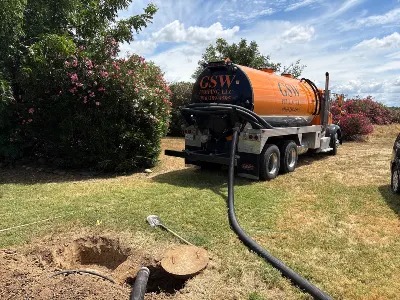
GSW Pumping LLC

5.0 (124) Antelope, CA 24/7

Customers consistently praise the team for punctual arrivals, honest advice, and clear communication about timing and costs. Reviewers also value the thorough pumping and cleaning, the before-and-after photos, and pricing they describe as competitive.

  • Punctual
  • Clear communication
  • Competitive pricing

Services:PumpingCleaningInspectionService

Contact See reviews Best in Antelope →

Septic Service Companies by city in California

Top-rated septic providers are spread across California, from the San Diego County area to Northern California and the Central Valley.

Los Angeles5 companies San Diego5 companies San Jose5 companies San Francisco5 companies Fresno5 companies Sacramento5 companies Long Beach5 companies Oakland5 companies Bakersfield5 companies Anaheim5 companies Stockton5 companies Riverside5 companies Irvine5 companies Santa Ana5 companies Chula Vista5 companies Santa Clarita5 companies Fremont5 companies San Bernardino5 companies Modesto5 companies Fontana5 companies Moreno Valley5 companies Oxnard5 companies Huntington Beach5 companies Glendale5 companies

California Septic Tank Laws & Requirements

California regulates onsite septic systems mainly through a statewide policy, which local agencies then apply in their own areas. Knowing which rules apply to you helps when you hire a contractor or plan a repair.

Who regulates it State Water Resources Control Board (OWTS Policy), implemented through the Regional Water Quality Control Boards and county or city environmental health departments

The State Water Board adopted the statewide OWTS (septic) Policy on June 19, 2012. It gives the regional water boards principal responsibility for implementing it. Local agencies can submit management programs for approval and then permit new and replacement systems under them. In practice, your county environmental health department is usually the office you deal with, and its rules may be stricter than the state minimum.

1

California Septic Tank Laws

The State Water Resources Control Board adopted the statewide OWTS (septic) Policy on June 19, 2012. It gives the Regional Water Quality Control Boards the main responsibility for carrying it out. In practice, your county environmental health department is usually the office that handles your system, and its rules can be stricter than the state minimum. Existing, properly functioning systems are placed in Tier 0, while systems near listed impaired water bodies can move to Tier 3, and Tier 4 sets corrective-action requirements. Owners must keep the system in good working order, with inspections and pumping as needed or as local ordinances require.

2

California Septic Tank Requirements

For new or replacement systems, the State Water Resources Control Board sets minimum setbacks of 5 feet from property lines and structures, 100 feet from water wells, and 100 feet from springs and flowing surface water. Tanks must have watertight risers on access openings, and wastewater entering new or replacement tanks is capped at 300 mg/L BOD, 330 mg/L TSS and 100 mg/L FOG. The policy also refers to tanks using an NSF/ANSI Standard 46 certified effluent filter. Counties may impose stricter distances through their local management programs, so check with your county before planning work.

3

California Septic Code

The California septic code is built on the OWTS Policy and on local Local Agency Management Programs approved under it. Humboldt County's program, for example, cites existing code calling for septic tank pumping every 7 years, while Ventura County's technical manual advises pumping every 2 to 3 years or as a licensed pumper recommends. Because there is no single statewide pumping interval, the local rules that apply to your property are the ones to confirm with your county environmental health department.

Key rules at a glance (13), with official sources
TopicRuleSource
Who regulatesImplementation involves system owners, local agencies with permitting powers (counties, cities), the Regional Water Boards and the State Water Board.waterboards.ca.gov
Legal basis / permitWater Code sections 13260 and 13269 require a Report of Waste Discharge (permit application) or a waiver for anyone discharging waste. The OWTS Policy provides a waiver of the section 13260 requirements if its conditions are met.waterboards.ca.gov
Tier systemExisting, properly functioning systems are automatically in Tier 0. A system moves to Tier 3 if it is next to a listed impaired water body. Tier 4 sets corrective-action requirements.waterboards.ca.gov
Setbacks (Tier 1 minimums)New or replacement systems must be at least 5 feet from property lines and structures, 100 feet from water wells, and 100 feet from springs and flowing surface water bodies. The policy also sets 100 feet from unstable land masses or earth-slide areas.waterboards.ca.gov
Local setbacks may be stricterThe Tier 1 setbacks are statewide minimums, and a county may impose stricter distances through its Local Agency Management Program (LAMP). This comes from a vendor summary, not an official source.onesourceplastics.com
Depth to groundwaterThe State Policy (Tier 1, section 8.1.5 and Table 2) sets a minimum depth to groundwater below the dispersal system, but I could not confirm the exact figure from the retrieved text. Mendocino County's technical standards state a 5-foot minimum, which may be waived down to no less than 2 feet under certain conditions.co.mendocino.ca.us
Tank design requirementsNew septic tanks must have watertight risers on access openings. New and replacement tanks are limited to wastewater not exceeding 300 mg/L BOD, 330 mg/L TSS or 100 mg/L FOG before the tank. The policy also refers to tanks using an NSF/ANSI Standard 46 certified effluent filter.waterboards.ca.gov
Maintenance / pumpingOwners must keep the system in good working condition, with inspections and pumping of solids as necessary or as local ordinances require. The state sets no single pumping interval.smchealth.org
Local pumping examples<cite index='41-6'>Humboldt County's program cites existing code requiring septic tank pumping every 7 years.</cite> <cite index='46-7'>Ventura County's technical manual advises pumping every 2-3 years, or as a licensed pumper recommends.</cite>waterboards.ca.gov
Inspection at property saleThe secondary sources I found say there is no statewide point-of-sale septic inspection law. <cite index='23-2'>Individual counties can impose one through local ordinance or their LAMP.</cite> <cite index='25-5'>Santa Cruz County, for example, has required a professional pump and inspection before a home with an onsite system can sell since July 1, 2023.</cite> I could not confirm this from an official county page.californiasepticguide.com
Seller disclosure<cite index='25-15'>The California Department of Real Estate says sellers must still disclose known septic issues through the state's Transfer Disclosure Statement.</cite> This is reported by a realtor blog.aaronderbacher.com
Failures and repairs<cite index='3-5'>Section 11.2 of the policy addresses septic tank failures such as a baffle failure or structural failure.</cite> The policy requires the tank to be brought into compliance with Section 8 requirements.waterboards.ca.gov
Approved tanksI found no official statewide list of approved tank brands. The OWTS Policy sets the performance and design rules, including the NSF 46 filter reference. A vendor page says tank sizing follows California Plumbing Code Chapter 7 and gives a 1,000-gallon minimum. I did not verify that against the code itself.onesourceplastics.com

Official sources:OWTS Policy - State Water Resources Control BoardOWTS Policy (adopted version) - State Water BoardOWTS FAQs - Central Coast Regional Water BoardOnsite Wastewater Information - Central Coast Regional Water BoardOWTS - Lahontan Regional Water Board (Region 6)C-42 Sanitation System Contractor - CSLB

Rules change and some counties add their own. Check with your county health department before you start work.

Septic Tank permits and licenses in California

The State Water Board's policy gives a conditional waiver of waste discharge requirements for systems that meet its tier conditions, but the construction or repair permit itself is issued by the local agency, usually the county environmental health department, under the policy or its approved local program. In the Lahontan region, memoranda of understanding let local agencies approve systems that meet Basin Plan septic criteria. Expect to provide site-evaluation information such as percolation and groundwater depth, and ask your county about application forms and fees before any work begins. Your septic contractor can often help prepare the paperwork for the permit.

How much does septic tank pumping cost in California?

In California, septic tank pumping typically runs $325 to $625, with an average of about $475, compared with a national range of $290 to $565 and an average of $430. A septic tank installation averages $8,305 in California, versus about $7,500 nationally, with a state range of $3,875 to $13,285. Replacement averages $7,195 in the state against $6,500 nationally, and repairs average $2,050 against $1,850. California prices sit above national averages across most services, so getting several quotes is worthwhile.

ServiceIn CaliforniaNational
Septic Tank Pumping Cost $325 – $625 $290 – $565 +10%
Septic Tank Installation Cost $3,875 – $13,285 $3,500 – $12,000 +11%
Septic Tank Maintenance $330 – $555 $300 – $500 +11%
Septic Tank Inspection $220 – $995 $200 – $900 +11%
Septic Tank Replacement Cost $3,320 – $11,070 $3,000 – $10,000 +11%
Septic Tank Cost $320 – $625 $290 – $565 +10%
Septic Tank Cleaning Cost $330 – $775 $300 – $700 +10%
Septic Tank Repair Cost $720 – $3,320 $650 – $3,000 +11%
Drain Field $3,320 – $16,605 $3,000 – $15,000 +11%
Aerobic Septic System $220 – $665 $200 – $600 +11%

Typical ranges: national prices adjusted to the cost of living in California (BEA regional price parities). Your quote depends on your property.

Use the cost calculator

Septic Tank services in California: FAQ

Do I need a septic tank permit in California?

Yes, new and replacement systems generally need approval from your local agency, usually the county environmental health department, under the State Water Board's OWTS Policy. Contact your county to confirm the forms, fees and site requirements.

What license do septic contractors need in California?

The Contractors State License Board classifies septic work under the C-42 Sanitation System Contractor license, which covers installing cesspools, septic tanks and sewage disposal structures. Check the CSLB website for current requirements and fees before hiring.

How much does septic tank pumping cost in California?

Septic tank pumping in California usually costs $325 to $625, with an average of about $475. Prices vary by tank size and location, so compare quotes from several local providers.

Get free quotes