Find your city

Type your city or ZIP code to see the best-rated septic service companies near you.

Get free quotes

Septic Tank Services in New Hampshire

The best-rated septic service companies across New Hampshire, plus state laws, permits and costs.

Looking for a septic tank New Hampshire homeowners can rely on? This guide covers the best-rated septic companies in the state, the rules set by the New Hampshire Department of Environmental Services, and what common septic work typically costs. Whether you are buying a property, planning a replacement or scheduling routine pumping, the sections below help you know what to ask for and what to expect.

5 cities20 companiesavg. 4.8★

Top 10 septic service companies in New Hampshire

The companies below are among the highest rated in New Hampshire, with listings in Manchester, Nashua, Rochester, Dover and Concord. Ratings and review counts are shown for each one, so you can compare providers in your area before you call.

Show map

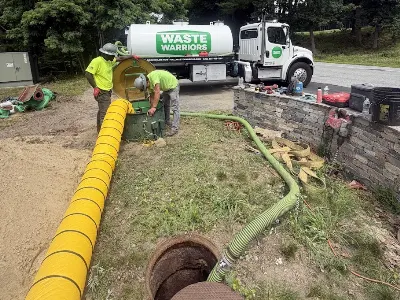
Waste Warriors

5.0 (89) Manchester, NH 24/7

Customers appreciate the knowledgeable technician who explains how their system works and arrives on time. Reviewers also like the appointment reminders, clear pricing, and the option of recurring pumping plans.

  • Punctual arrivals
  • Maintenance plans
  • Clear communication

Services:PumpingMaintenanceService

Contact See reviews Best in Manchester →

Hamm Septic Services

4.9 (198) Nashua, NH

Reviewers value the technicians' knowledge and willingness to explain how a septic system works and where its access points are. The main recurring note is that one visit came earlier than the scheduled time.

  • Knowledgeable technicians
  • Explains the system
  • Pumping service

Services:PumpingInstallation

Contact See reviews Best in Nashua →

L. W. Morgridge & Son, Inc.

4.9 (75) Dover, NH 24/7

Customers consistently praise the team for prompt, thorough work and for responding quickly in emergencies, including diagnosing a false alarm and clearing a lift station. Many clients stay with the company year after year for periodic cleaning and inspections, and they single out specific technicians for friendliness and skill.

  • Emergency response
  • Periodic maintenance
  • Friendly technicians

Services:PumpingInspectionCleaningMaintenanceServiceRepair

Contact See reviews Best in Dover →

Sewer Surgeons

4.8 (301) Concord, NH 24/7

Customers appreciate how quickly this company can fit in inspections and pumping jobs, along with the crews' professionalism and courteous manner. Many say they keep returning, though one customer felt the pumping cost was higher than what they usually paid.

  • Prompt response
  • Professional crews
  • Pumping and inspections

Services:PumpingInspectionRepair

Contact See reviews Best in Concord →

#8

McKenna Septic Service

4.8 (30) Dover, NH 24/7

Customers describe the owner and crew as professional, friendly, and happy to explain how a septic system works, which many newcomers find valuable. Clients also appreciate reliable scheduling, tidy cleanup, and willingness to respond to urgent calls even outside regular hours.

  • Local family business
  • Emergency help
  • Clear explanations

Services:PumpingService

Contact See reviews Best in Dover →

LaPierre Septic

4.6 (134) Rochester, NH

Many customers praise quick response times and skilled repairs, including fixing a float and pump problem and rearranging appointments on short notice. However, several reviewers report unreturned calls and one describes a leak during service that the company did not take responsibility for.

  • Quick repairs
  • Unreturned calls
  • Mixed reviews

Services:PumpingServiceRepair

Contact See reviews Best in Rochester →

Septic Service Companies by city in New Hampshire

Septic service coverage in New Hampshire is spread across several cities, and each area has its own local providers. Manchester, Nashua, Rochester, Dover and Concord each have companies with strong ratings, so start with the city closest to your property.

New Hampshire Septic Tank Laws & Requirements

Septic systems in New Hampshire are regulated at the state level and, in many towns, at the local level. Knowing which rules apply to your property helps you avoid delays during a sale, repair or installation.

Who regulates it New Hampshire Department of Environmental Services (NHDES) – Subsurface Systems Bureau

Septic system (ISDS) permitting in New Hampshire is regulated by NHDES's Subsurface Systems Bureau under the Env-Wq 1000 rules and RSA 485-A. There is no general statewide inspection at sale and no fixed pumping mandate, but waterfront sales have a special evaluation rule, and some towns add local rules.

1

New Hampshire Septic Tank Laws

Septic systems in New Hampshire are regulated by the New Hampshire Department of Environmental Services (NHDES), through its Subsurface Systems Bureau, under the Env-Wq 1000 rules and RSA 485-A. Local health officers enforce local septic regulations, and towns can add their own requirements for construction or expansion. There is no general statewide inspection at sale and no fixed pumping mandate for ordinary homes, but waterfront properties follow a special evaluation rule when the septic system sits within 250 feet of the shoreline.

2

New Hampshire Septic Tank Requirements

Before a system is installed, replaced or expanded, the NHDES Subsurface Systems Bureau must grant written approval. A new system needs both a Construction Approval and an Operational Approval before it can be legally used. The installed system must be left uncovered for inspection and cannot be used until it receives an Approval for Operation. NHDES says tanks should be pumped every three to five years by an NHDES-licensed septage hauler, and systems with pretreatment or pumps need maintenance contracts and alarms.

3

New Hampshire Septic Code

The state septic code sets minimum distances between a septic tank and features such as surface water, wetlands, culverts and private wells. Env-Wq 1008 contains these setback tables, and the distances may be reduced under certain conditions. Because the code has been revised recently, confirm the current setback table with NHDES before designing or siting a system. Tank replacement must use a tank of the same or larger liquid capacity that meets the Env-Wq 1010 standards.

Key rules at a glance (15), with official sources
TopicRuleSource
Who regulates<cite index="1-5">Before a system is installed, replaced, or expanded, NHDES Subsurface Systems Bureau must grant written approval</cite>, and <cite index="1-1">local health officers enforce local septic regulations</cite>.dhhs.nh.gov
Two-stage approval<cite index="2-6">To be legally installed, an ISDS must have both an NHDES Construction Approval and an Operational Approval.</cite>des.nh.gov
Approval validity<cite index="5-5">A sample NHDES Construction Approval states it is valid for 4 years from approval, per Env-Wq 1004.13</cite>, while <cite index="2-3">approvals for replacing failed systems are valid for 90 days from issuance</cite>. A secondary website says 2 years, which conflicts with the official approval document.barrington.nh.gov
Inspection before use<cite index="5-10">The installed system must be left uncovered and cannot be used until it is inspected and has received an Approval for Operation.</cite>barrington.nh.gov
Inspection at sale (waterfront)<cite index="28-3,28-4">Under RSA 485-A:39, a developed waterfront property with any part of its septic system within 250 feet of the shoreline triggers a mandatory evaluation on sale, and the buyer is primarily responsible.</cite>mclane.com
Waterfront sale details<cite index="33-11">If the inspection shows the system is failing, it must be repaired or replaced within 180 days after the transfer.</cite> <cite index="33-13">If the system was never NHDES-approved or was approved before September 1989, a licensed septic system designer must evaluate it.</cite> These details come from a realtor blog, not an official source.northconwayrealty.com
Inspection at sale (non-waterfront)<cite index="32-6">Outside the waterfront trigger, a secondary source says there is no NH statewide point-of-sale septic inspection requirement.</cite> I could not confirm this on an official NHDES page.clickseptic.com
Setbacks (Env-Wq 1008)In the Env-Wq 1008.04 table, <cite index="15-1">a septic tank must be 75 ft from surface water, 50 ft from poorly drained jurisdictional wetland, 75 ft from very poorly drained wetland and open drainage, 10 ft from a culvert, and 35 ft from a catch basin.</cite> The Justia copy may predate the revision, because <cite index="10-2">the General Court site shows the setback section was replaced effective 2-1-26 and renumbered Env-Wq 1008.05</cite>. Check the current table before design.regulations.justia.com
Setback reductions<cite index="15-1">The tank-to-surface-water, open-drainage, very-poorly-drained-soil, or private-well distance may be reduced to 50 feet if certain conditions are met.</cite>regulations.justia.com
Pumping<cite index="37-1,37-2">NHDES says septic tanks should be pumped every three to five years, using an NHDES-licensed septage hauler.</cite> I found no official statewide mandatory pumping schedule for ordinary homes.des.nh.gov
Failed systems<cite index="18-7">The owner of an ISDS in failure must stop using the effluent disposal area, including by having a licensed septage hauler pump the tank often enough to prevent wastewater from exiting it</cite> (Env-Wq 1004.20).irp-cdn.multiscreensite.com
Pretreatment and pump systems<cite index="3-10">Owners of systems with pretreatment must provide a maintenance contract copy as part of construction approval, and pumped systems need a visual and audible alarm.</cite>des.nh.gov
Tank sizing and replacement<cite index="10-4">An existing tank can be replaced with one of the same or larger liquid capacity that meets Env-Wq 1010.01 and 1010.02.</cite> Septic design is based on bedroom count, so <cite index="2-6">check that the bedroom count on the approvals matches the real estate listing</cite>.gc.nh.gov
Local rules<cite index="1-6">Municipalities can regulate septic construction or expansion locally.</cite> Some towns charge a separate fee, for example <cite index="4-3">Holderness requires a $40 local permit fee</cite>.holderness-nh.gov
Records lookup<cite index="2-6">For systems approved since 1986, records can be viewed on the NHDES OneStop Subsurface Query.</cite>des.nh.gov

Official sources:NHDES Septic Designer and InstallerNHDES SSB-6 Before You Buy a PropertyNHDES SSB-13 You and Your Septic SystemNHDES Get Pumped! New HampshireNH General Court – Env-Wq 1000 RulesEnv-Wq 1008.04 Minimum Distances (Justia)

Rules change and some counties add their own. Check with your county health department before you start work.

Septic Tank permits and licenses in New Hampshire

A septic system in New Hampshire cannot be installed, replaced or expanded without written NHDES Construction Approval. The application must be prepared by a permitted designer, and once the work is complete NHDES inspects the system and issues an Approval for Operation. Many towns also require a separate local permit, so check with your town office early. Review the current NHDES fee schedule before you submit, since application fees and local charges vary by municipality.

How much does septic tank pumping cost in New Hampshire?

Typical septic work in New Hampshire runs close to the national averages. Septic tank pumping in the state ranges from $305 to $590, with an average of $445, compared with a national range of $290 to $565. A full septic tank installation averages $7,815 in New Hampshire, between $3,645 and $12,505, while the national average is $7,500. Repairs average $1,930 in the state, and drain field work averages $8,335, both slightly above national figures.

ServiceIn New HampshireNational
Septic Tank Pumping Cost $305 – $590 $290 – $565 +3%
Septic Tank Installation Cost $3,645 – $12,505 $3,500 – $12,000 +4%
Septic Tank Maintenance $315 – $520 $300 – $500 +4%
Septic Tank Inspection $210 – $940 $200 – $900 +5%
Septic Tank Replacement Cost $3,125 – $10,420 $3,000 – $10,000 +4%
Septic Tank Cost $300 – $590 $290 – $565 +3%
Septic Tank Cleaning Cost $315 – $730 $300 – $700 +3%
Septic Tank Repair Cost $675 – $3,125 $650 – $3,000 +4%
Drain Field $3,125 – $15,630 $3,000 – $15,000 +4%
Aerobic Septic System $210 – $625 $200 – $600 +4%

Typical ranges: national prices adjusted to the cost of living in New Hampshire (BEA regional price parities). Your quote depends on your property.

Use the cost calculator

Septic Tank services in New Hampshire: FAQ

Do I need a septic tank permit in New Hampshire?

Yes. A septic system cannot be installed, replaced or expanded without written approval from the NHDES Subsurface Systems Bureau. Many towns also require a local permit, so check both before starting work.

Is a septic license required in New Hampshire?

Septic systems must be built by an NHDES-permitted installer, except when a homeowner installs a system for their own primary home. Designers take a two-part written exam and must also pass a field soil test, and septic system evaluators are licensed separately through the NH OPLC.

How much does septic tank pumping cost in New Hampshire?

Septic tank pumping in New Hampshire typically costs between $305 and $590, with an average of $445. That is slightly above the national average of $430, so compare quotes from local providers before booking.

Get free quotes