| Who regulates | <cite index="11-4">The administrative authority, typically the county board of health, evaluates all private sewage disposal construction permit applications to make sure they meet state and federal requirements.</cite> | rules.iowa.gov |
| What counts as a private system | <cite index="15-4">A private sewage disposal system treats domestic sewage from four or fewer dwelling units, or the equivalent of fewer than 16 people on a continuing basis.</cite> <cite index="12-5">The definition covers septic tanks, holding tanks, chemical toilets, vault toilets and portable toilets.</cite> | law.cornell.edu |
| Construction permit | <cite index="12-14">No private sewage disposal system may be installed or altered without a construction permit from the administrative authority.</cite> <cite index="15-5,15-6">Alteration means any change that affects treatment or disposal. Repairing existing components without changing treatment or disposal is exempt.</cite> | law.cornell.edu |
| Time of transfer inspection (sale) | <cite index="5-1">Iowa Code 455B.172 requires every home or building served by a private sewage disposal system to have it inspected before the sale or deed transfer.</cite> <cite index="3-2">The inspector must be certified by the Iowa DNR.</cite> | iowadnr.gov |
| Inspection contents and validity | <cite index="4-6">The inspector locates all components, pumps the tank, visually inspects the system and runs a load test.</cite> <cite index="4-7">County staff review the report, and it is valid for two years.</cite> <cite index="4-8">If the inspection fails, the owner and/or realtors are told what repairs or replacement are required.</cite> | muscatinecountyiowa.gov |
| Time of transfer exemptions and waivers | <cite index="4-11,4-13,4-15">Iowa code allows three waivers, including future demolition and a later inspection when weather or physical conditions prevent one.</cite> The DNR publishes a list of exemptions under Iowa Code 455B.172(11). The third waiver and the full exemption list are not detailed in the sources I retrieved. | webstercountyia.gov |
| Setbacks (separation distances) | <cite index="39-4">Under the current rule, the minimum distance from a private water supply well is 50 feet for the closed portion (septic tank) and 100 feet for the open portion (absorption field).</cite> The same table gives 50 and 100 feet for a lake or reservoir, and 200 and 400 feet for a shallow public well. Other distances in the full table, such as to structures and ditches, are in the rule. | iowadnr.gov |
| Soil absorption field limits | <cite index="40-6,40-8">The vertical separation from the trench bottom to groundwater, bedrock or another confining layer can never be less than three feet, and no trench may exceed 100 feet unless the administrative authority allows it.</cite> | legis.iowa.gov |
| Tank design and access | <cite index="13-8,13-9">Tank access openings must be at least 18 inches in the smallest dimension, and watertight risers of at least 18 inches in diameter must bring them to the ground surface.</cite> <cite index="13-10">Risers must be secured against tampering.</cite> | legis.iowa.gov |
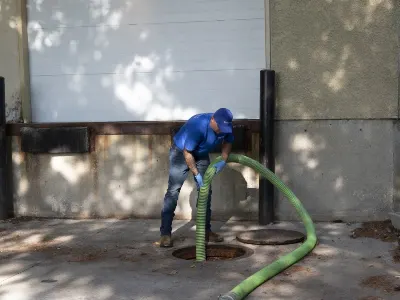
| Pumping/cleaning rule | <cite index="21-1">Chapter 68 requires septic tanks to be pumped only by a licensed commercial septic tank cleaner.</cite> <cite index="27-3">The owner of a septic tank may clean the owner's own tank.</cite> The DNR rule text does not set a mandatory pumping interval for ordinary conventional systems, as far as I could find. | iowadnr.gov |
| Maintenance of treatment units | <cite index="14-16">A primary treatment system must be inspected, monitored and maintained per the manufacturer's specifications and third-party certification, or at least once a year, whichever is more frequent.</cite> This text is from the 2025 version of Chapter 69, and the exact scope is in the rule. | legis.iowa.gov |
| Discharge and abandonment | <cite index="12-7">Discharging wastewater from a private system to a ditch, stream, pond, lake, drain tile, groundwater or the ground surface is prohibited except as the chapter permits.</cite> <cite index="12-12">An abandoned system must have its tank pumped, the lid crushed into the tank, and the tank filled with sand or soil.</cite> | law.cornell.edu |
| Approved tanks | I found no official DNR list of pre-approved tank brands in these sources. The rule instead sets design standards, and <cite index="13-17">the administrative authority may ask for proof before approving a tank.</cite> Check with the county sanitarian for local approval. | legis.iowa.gov |
| Financial help | <cite index="30-2">The Onsite Wastewater Assistance Program is for owners of existing homes with septic systems in areas not served by public sewer.</cite> <cite index="30-3">The first step is to get a septic construction permit from the county sanitarian.</cite> | opportunityiowa.gov |