Find your city

Type your city or ZIP code to see the best-rated septic service companies near you.

Get free quotes

Septic Tank Services in New Mexico

The best-rated septic service companies across New Mexico, plus state laws, permits and costs.

Septic tank service in New Mexico is regulated at the state level, so the rules, permits and licensing you need depend on where your property sits. This page lists the top-rated septic tank companies across the state, explains the main requirements set by the New Mexico Environment Department, and shows how typical project prices compare with national figures. Use it to shortlist providers and understand what to expect before any work starts.

11 cities31 companiesavg. 4.8★

Top 10 septic service companies in New Mexico

The companies below are among the highest rated in the directory, with ratings and review counts shown for each. Compare the cities they serve to find a provider close to your property.

Show map

Jontel Septic LLC

4.9 (135) Alamogordo, NM 24/7

Customers consistently praise the crew's punctuality, respectful conduct, and tidy job sites, plus fast response on urgent calls. A recurring concern is a delay in communication and an early oversight on one emergency repair, which the owner did make right.

  • Fast response
  • Clean job sites
  • Emergency service

Services:PumpingCleaningRepairRiser InstallationService

Contact See reviews Best in Alamogordo →

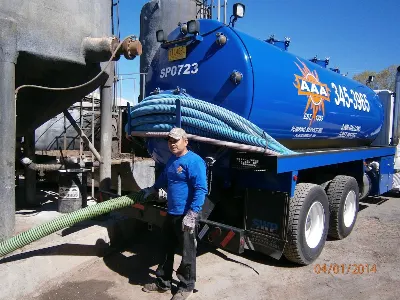
AAA Pumping Service

4.8 (148) Albuquerque, NM

Reviewers value this company's friendly staff, timely scheduling, and fair pricing, especially for event portable toilet and pumping work that they have used repeatedly over the years. The most serious complaint involves a large event where the crew arrived a full day late and handled the visit poorly.

  • Event services
  • Timely scheduling
  • Fair pricing

Services:PumpingService

Contact See reviews Best in Albuquerque →

Johnny's Septic Tank Co

4.7 (401) Las Cruces, NM

Clients value the company's long-term reliability, professional crews, and honest advice that steers them toward cleaning rather than costly replacement when appropriate. The main recurring suggestion is for more frequent email status updates during permitting and installation projects.

  • Long-term clients
  • Honest advice
  • Installation crews

Services:InstallationReplacementCleaningRepairServiceMaintenancePumping

Contact See reviews Best in Las Cruces →

RC Septic Installation & Repair

4.8 (19) Rio Rancho, NM

Customers value the crews for arriving on time, giving honest upfront pricing, and avoiding unnecessary replacements, such as inspecting a tank another company wanted to replace. One reviewer raised a complaint about a driver's conduct in a parking lot incident unrelated to the septic work itself.

  • Honest pricing
  • Punctual crews
  • Installation and repair

Services:PumpingInstallationReplacementRepairInspectionDrain Field ServicesServiceRiser InstallationMaintenanceCleaning

Contact See reviews Best in Rio Rancho →

Septic Service Companies by city in New Mexico

Septic providers are spread across several New Mexico cities, from Albuquerque and Santa Fe to Las Cruces, Hobbs and Alamogordo. Choosing a company close to your home usually means faster scheduling for pumping, inspections and emergency repairs.

New Mexico Septic Tank Laws & Requirements

Septic systems in New Mexico follow a single state rulebook, so the same core standards apply whether you live in a city or a rural area. Knowing which agency governs the work and which rules apply to your lot helps you avoid delays and costly corrections.

Who regulates it New Mexico Environment Department (NMED), Environmental Health Bureau – Liquid Waste (Onsite Wastewater) Program

Septic systems in New Mexico are regulated under 20.7.3 NMAC (Liquid Waste Disposal and Treatment Regulations), administered by NMED. NMED issues the permits, and CID-licensed contractors do the installation. Unincorporated Bernalillo County runs its own program (see points below).

1

New Mexico Septic Tank Laws

Septic systems in New Mexico are regulated under 20.7.3 NMAC, the Liquid Waste Disposal and Treatment regulations. The New Mexico Environment Department (NMED), through its Environmental Health Bureau Liquid Waste (Onsite Wastewater) Program, issues the permits and must approve septic tank and proprietary drainfield products before installation. Unincorporated Bernalillo County runs its own program instead, so property owners there should confirm which office handles their paperwork before starting any project.

2

New Mexico Septic Tank Requirements

Anyone without access to a community sewer needs an NMED Liquid Waste Permit before building or moving a home onto a property. A permit is also required to modify the system, replace part or all of it, change the disposal method or design flow, or change the lot size. Lots under 0.75 acre generally cannot take a conventional system where no on-site system exists, and setback distances from property lines, buildings and wells are set in Table 302.1 of 20.7.3.302 NMAC.

3

New Mexico Septic Code

The septic code bars putting household hazardous wastes, solvents, fertilizers, livestock wastes or vehicle wash water into an on-site system. Treatment additives may not be used to reduce how often proper maintenance and septage removal are done. Tank access openings must be at least 20 inches in minimum dimension, with covers secured by corrosion-resistant fasteners. Only contractors holding the appropriate CID license may build or modify a system, unless a qualified homeowner is doing the work.

Key rules at a glance (15), with official sources
TopicRuleSource
Regulator and rule<cite index="1-4">The governing rule is the Liquid Waste Disposal and Treatment regulations, 20.7.3 NMAC.</cite> <cite index="1-1">NMED must review and approve a septic tank or proprietary drainfield product before a permit is issued for its installation.</cite>env.nm.gov
Permit required<cite index="6-2">Anyone without access to a community sewer must obtain an NMED Liquid Waste Permit before building or transporting a home onto a property.</cite> <cite index="6-3,6-4">A permit is also needed to modify the system or property, for example to change the disposal method or design flow, replace part or all of the system, or change the lot size.</cite> (This is from an advocacy fact sheet that summarizes the rule.)amigosbravos.org
Permit process and validity<cite index="8-6,8-7,8-8">You pay only after NMED approves the application. A Permit to Construct is then issued and is valid for one year, which NMED can extend in writing.</cite> <cite index="3-10">After an approved inspection you receive a Permit to Operate.</cite>env.nm.gov
Fees (homeowner route)<cite index="7-4">The Homeowner Qualification Certificate application costs $170, and the Liquid Waste Permit or Registration application costs $225 for systems of 1,000 gpd or less.</cite>env.nm.gov
Who may install<cite index="7-2">Companies holding an MM-1, MM-98, MS-1 or MS-3 contractor license from the New Mexico Construction Industries Division can install, modify or evaluate liquid waste systems.</cite>env.nm.gov
Homeowner self-install<cite index="7-7">A homeowner must pass an exam administered by NMED to be qualified to install an on-site system.</cite> <cite index="23-3,23-4">A qualified homeowner may install no more than one system in 12 months and may not pay anyone to do any phase of construction unless that person holds the appropriate CID license.</cite>srca.nm.gov
Inspection at sale / transfer of ownership<cite index="29-10,29-11">An advocacy fact sheet says a transfer-of-ownership inspection by a licensed installer or NAWT-certified party is required at sale, and that a waiver may be granted if a permitted or registered system was inspected within the last 180 days.</cite> <cite index="28-2">An inspection brochure says the current owner must have the system inspected and evaluated by a qualified professional.</cite> Some non-official sources disagree: <cite index="39-7">one says New Mexico does not mandate statewide septic inspections for property transfers.</cite> I did not retrieve the exact regulation text on this point, so check with your local NMED field office.amigosbravos.org
Failed inspection (secondary source)<cite index="30-13,30-14">A realty-sector source says the owner of record 180 days after a failed inspection is responsible for repairs, and the home may be red-tagged by NMED if repairs are not done in that time.</cite>questanews.com
Unpermitted existing systems<cite index="6-10">Unpermitted existing systems must apply to NMED for a Certificate of Registration.</cite> <cite index="46-8">After the system is evaluated, the owner applies to NMED for the Certificate of Registration for continued operation if the system is outside Bernalillo County.</cite>keeptheriogrand.org
Minimum lot size<cite index="14-2">A conventional treatment system may not be installed on a lot smaller than 0.75 acre where there is no established on-site liquid waste system, except as provided in 20.7.3.301(F).</cite> <cite index="11-8">Lots over 500 gallons per day per acre or under 0.75 acre can require tertiary treatment.</cite>srca.nm.gov
Setbacks<cite index="11-7">Setback distances are set in Table 302.1 of 20.7.3.302 NMAC.</cite> <cite index="16-1">They apply to any part of the system and its designated replacement area.</cite> The table covers property lines, buildings, distribution boxes and other features. A non-official site gives 50 feet from a potable well as a baseline, but I did not verify this in the official table, so check the table itself.law.cornell.edu
Pumping and maintenanceI found no statewide mandatory pumping interval in the official sources. <cite index="14-4">The regulation says treatment additives may not be used to reduce the frequency of proper maintenance and septage removal.</cite> <cite index="5-4">NMED keeps a list of qualified septage pumpers on its website.</cite> The commonly cited 3–5 year interval comes from non-official sources, e.g. <cite index="41-1">a local septic company saying tanks typically need pumping every 3–5 years.</cite>srca.nm.gov
Prohibited waste<cite index="14-3">No one may put household hazardous wastes, solvents, fertilizers, livestock wastes, or vehicle and equipment wash water into an on-site system.</cite>srca.nm.gov
Tank lid safety<cite index="38-18">Each septic tank must have at least two access openings, each at least 20 inches in minimum dimension.</cite> <cite index="38-19">Covers must have approved fasteners that resist corrosion so they stay in place.</cite>sjcounty.net
Local variation<cite index="44-11">One local contractor states that unincorporated Bernalillo County falls under its own wastewater ordinance rather than NMED.</cite> <cite index="28-5">The inspection brochure likewise directs Bernalillo County permit searches to Bernalillo County Natural Resource Services.</cite>keeptheriogrand.org

Official sources:NMED Liquid Waste Program (Onsite Wastewater) – Homeowners InformationNMED – Liquid Waste Permitting ProcessNMED – Approved Products20.7.3 NMAC – New Mexico State Records Center & ArchivesN.M. Admin. Code § 20.7.3.302 – Setback Requirements (Cornell LII)NMED LW-904 Qualification Requirements for Liquid Waste Professionals

Rules change and some counties add their own. Check with your county health department before you start work.

Septic Tank permits and licenses in New Mexico

Before work begins, the owner or owner's representative submits an NMED application with supporting documents, and NMED reviews it. You pay only after approval. A Permit to Construct is then issued and stays valid for one year, and NMED can extend it in writing. After an approved inspection you receive a Permit to Operate. If you disagree with an NMED permit decision, you may appeal to the NMED Secretary under 20.7.3.406 NMAC.

How much does septic tank pumping cost in New Mexico?

Typical septic tank pumping in New Mexico runs $270 to $520, with an average of $395, compared with a national range of $290 to $565 and a national average of $430. Installation is also lower in the state, averaging $6,915 against a national average of $7,500. Replacement averages $5,995 in New Mexico versus $6,500 nationally, while drain field work averages $7,375 against $8,000. Prices are typical project ranges and actual quotes depend on tank size, access and site conditions.

ServiceIn New MexicoNational
Septic Tank Pumping Cost $270 – $520 $290 – $565 -8%
Septic Tank Installation Cost $3,225 – $11,065 $3,500 – $12,000 -8%
Septic Tank Maintenance $275 – $460 $300 – $500 -8%
Septic Tank Inspection $185 – $830 $200 – $900 -8%
Septic Tank Replacement Cost $2,765 – $9,220 $3,000 – $10,000 -8%
Septic Tank Cost $265 – $520 $290 – $565 -8%
Septic Tank Cleaning Cost $275 – $645 $300 – $700 -8%
Septic Tank Repair Cost $600 – $2,765 $650 – $3,000 -8%
Drain Field $2,765 – $13,830 $3,000 – $15,000 -8%
Aerobic Septic System $185 – $555 $200 – $600 -8%

Typical ranges: national prices adjusted to the cost of living in New Mexico (BEA regional price parities). Your quote depends on your property.

Use the cost calculator

Septic Tank services in New Mexico: FAQ

Do I need a septic tank permit in New Mexico?

Yes, if your property is not connected to a community sewer. You need an NMED Liquid Waste Permit before building, moving a home onto the lot, or modifying or replacing the system. Permits must be approved before work starts, and a Permit to Construct is valid for one year.

Do I need a septic license to work on a septic system in New Mexico?

Contractors who install, modify or evaluate liquid waste systems need an MM-1, MM-98, MS-1 or MS-3 license from the New Mexico Construction Industries Division. A qualified homeowner may install one system per 12 months after passing an NMED exam, but cannot pay anyone without the proper CID license to do any phase of construction.

Is a septic license the same as a septic permit in New Mexico?

No. A license applies to the person or company doing the work, issued through the Construction Industries Division. A permit applies to the project itself and is issued by NMED. Most septic installations need both a licensed contractor and an approved NMED permit.

Get free quotes