| Who regulates | CDPHE says OWTS are governed by Regulation 43, that counties conduct permitting for systems with flows of 2,000 gallons per day or less, and that each local public health agency has adopted regulations at least as stringent as Regulation 43. | cdphe.colorado.gov |
| Large systems | OWTS with flows greater than 2,000 gallons per day must go through the state's design review facility approval process rather than only a county permit. | cdphe.colorado.gov |
| Permit required | Regulation 43.4 says that before installing, altering or repairing a system, the applicant must obtain a permit from the local public health agency. | law.cornell.edu |
| Permit surcharge | The local agency must collect a surcharge on each permit for a new, repaired or upgraded OWTS and send it to CDPHE to fund the state OWTS program. An older version of the rule set this at $23, with $20 going to CDPHE and $3 kept locally, and I did not confirm the current amount. | la-h-health.colorado.gov |
| Property access and permit revocation | The owner or occupant of any property with an OWTS must allow the local public health agency access to inspect, test, sample and monitor compliance, and the agency may revoke a permit for non-compliance. | law.cornell.edu |
| Inspection at property sale | Regulation 43 does not require a sale inspection statewide. It lets a local board of health choose a Transfer of Title inspection program, and the transfer inspectors must be certified by the National Association of Wastewater Technicians (NAWT) or an equivalent program approved by CDPHE and the local agency. | law.cornell.edu |
| Transfer of Title programs vary by county | CDPHE publishes a map of the local agencies that run a Transfer of Title inspection program. Northeast Colorado Health Department, for example, lists transfer inspections in its local regulation. A law-firm blog (not an official source) says 22 counties explicitly require one, so check with your county. | cdphe.colorado.gov |
| Setbacks (soil treatment area) | Table 7-1 of Regulation 43 sets minimum distances from the soil treatment area of 100 feet to an on-site well, 50 feet to a pond, creek, lake or other surface water, and 25 feet to a dry gulch or cut bank. Reductions to the 100-foot well distance must meet Division of Water Resources well variance rules, and local boards may require more. | law.cornell.edu |
| Setbacks (septic tank to well) | A secondary, non-official guide states the septic tank must be at least 50 feet from a private well. The Table 7-1 extract I retrieved lists 50 feet as the first value in the septic tank row, but its column labels were garbled, so confirm this with your county. | septictankhub.com |
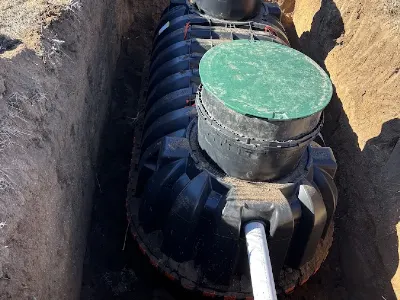
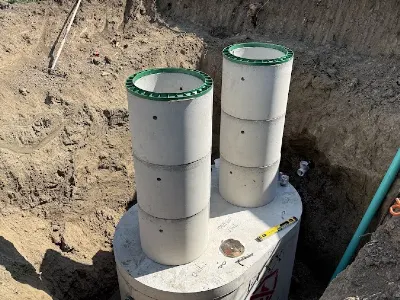
| Tank size and design | Regulation 43 requires a septic tank to have at least 25 square feet of liquid surface area, and a combined tank in series also needs at least 25 square feet. | sos.state.co.us |
| Approved tanks and products | CDPHE must provide initial review and acceptance of OWTS products and technology, and it publishes a 'Septic tank acceptance summary list' on its OWTS page. The list's contents were not retrieved. | cdphe.colorado.gov |
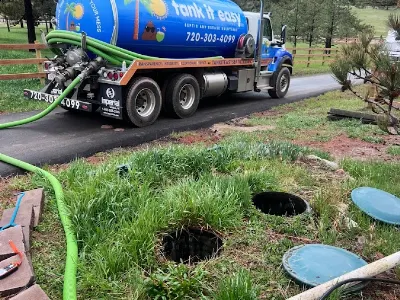
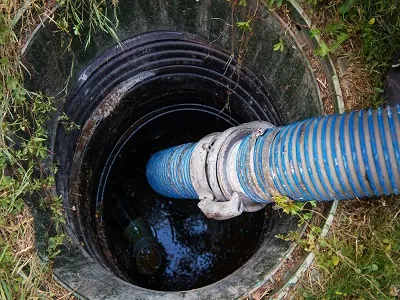
| Pumping and maintenance | I found no statewide pumping interval in the official sources. Regulation 43 requires local agencies with permitted higher-level systems to have a maintenance oversight program, and some counties set their own pumping or inspection schedules, so ask your local health department. Routine pumping itself does not need a permit, according to a secondary source. | sos.state.co.us |
| Local permit expiry (example) | In one example of a local rule, Northeast Colorado Health Department says an OWTS permit expires one year after issuance if construction has not started. | nchd.org |
| Engineered design | Some counties require a Colorado-registered Professional Engineer to design every OWTS. Eagle County and Mineral County are examples. | eaglecounty.us |