Find your city

Type your city or ZIP code to see the best-rated septic service companies near you.

Get free quotes

Septic Tank Services in North Carolina

The best-rated septic service companies across North Carolina, plus state laws, permits and costs.

Looking for a septic tank in North Carolina? This guide covers the top-rated local companies, the state rules that govern on-site wastewater systems, and what septic tank pumping, repair and replacement typically cost in the state compared with national averages.

39 cities122 companiesavg. 4.9★

Top 10 septic service companies in North Carolina

The companies below are among the highest-rated septic providers in North Carolina, with ratings of 5 and a range of review counts, from Wake Forest and Asheville to Durham and Salisbury.

Show map

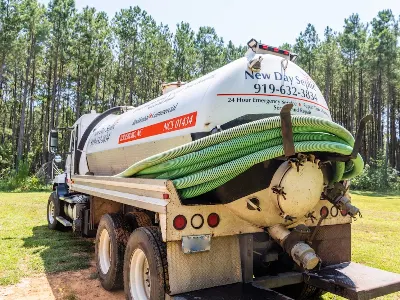
New Day Septic

5.0 (1,069) Wake Forest, NC 24/7

Customers appreciate the team's reliability, quick responses, and friendly staff, and several said the pricing is competitive. Reviewers also liked that the crew restored the yard after digging up the tank and cleaned the filter as part of the job.

  • Reliable
  • Responsive
  • Fair pricing

Services:PumpingMaintenanceCleaningServiceRiser Installation

Contact See reviews Best in Wake Forest →

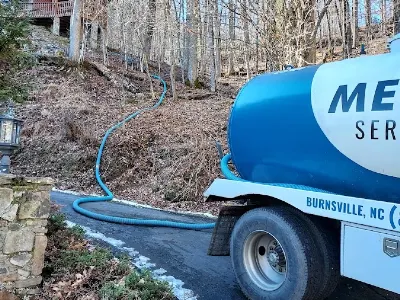
Metcalf Septic Services

5.0 (445) Asheville, NC 24/7

Customers appreciate the family crew's clear communication, fair transparent pricing, and willingness to tackle difficult sites, including a full tank replacement on rocky terrain. Several reviewers also noted that they caught problems that other inspectors had missed.

  • Clear communication
  • Fair pricing
  • Difficult site work

Services:PumpingInspectionReplacementCleaningServiceInstallation

Contact See reviews Best in Asheville →

Seabound Septic Services & Waste Management

5.0 (135) Fuquay-Varina, NC

Reviewers praise the team for transparent recommendations, a clear explanation of the work, and no pressure to buy extra services. Quick scheduling, punctual arrivals, and reasonable pricing are also frequently mentioned, with no recurring complaints.

  • No upselling
  • Same-day service
  • Clear explanations

Services:PumpingCleaningInspectionDrain Field ServicesMaintenance

Contact See reviews Best in Fuquay-Varina →

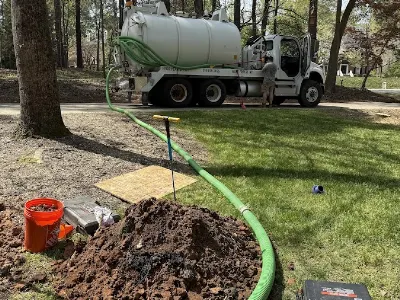
Heck Yeah Septic

5.0 (127) Cary, NC

Reviewers value the company's punctuality, friendly communication, and straightforward pricing without upselling. Customers also appreciate the photos and walkthroughs that show what was found and what work was actually needed.

  • No upselling
  • Punctual
  • Detailed walkthroughs

Services:PumpingMaintenanceInspection

Contact See reviews Best in Cary →

North Carolina Septic Tank Laws & Requirements

Septic systems in North Carolina follow a single statewide framework, so the rules you face at home in Asheville are the same ones that apply in Wake Forest or Salisbury.

Who regulates it NC Department of Health and Human Services, Division of Public Health, Environmental Health Section, On-Site Water Protection Branch (with county health departments)

North Carolina septic systems are regulated statewide by the DHHS On-Site Water Protection Branch under 15A NCAC 18E, which was rewritten and took effect January 1, 2024. County health departments handle the local permitting and inspections, and installers and inspectors are certified by a separate state board. I did not find an official state rule that sets a pumping schedule or requires an inspection when a home is sold.

1

North Carolina Septic Tank Laws

Septic systems across the state are regulated under 15A NCAC 18E, which governs wastewater treatment and dispersal systems under G.S. 130A-335. The rules were rewritten and took effect January 1, 2024, the first full rewrite in more than 30 years. Local county environmental health offices carry out the day-to-day work, while the NC Department of Health and Human Services, Division of Public Health, Environmental Health Section, On-Site Water Protection Branch (with county health departments) sets the statewide standards and approves tanks and products.

2

North Carolina Septic Tank Requirements

Any new system starts with a two-stage county permit: an Improvement Permit for the soil and site evaluation, followed by a Construction Authorization for the design. Building permits or installation can proceed only after the Construction Authorization is issued. Repairs require a permit when a system is damaged or failing, and an expansion permit is needed when design flow or wastewater strength increases. All prefabricated tanks and related parts such as effluent filters and risers must be approved by the On-Site Water Protection Branch, and well setbacks of 50 feet from a private well and 100 feet from a public supply well apply under 15A NCAC 18E .0601.

3

North Carolina Septic Code

The state code sets minimum distances between a wastewater system and features such as wells, and it also governs additions. Under the Quick Reference Guide, the 100-foot well setback can be reduced to 50 feet when a variance is issued for the well. Property owners adding a pool or building near an existing system are responsible for meeting the Section .0600 setbacks, and the county can issue an existing system approval. Confirm the exact property-line distance with your county, since the figure varies between code tables.

Key rules at a glance (10), with official sources
TopicRuleSource
Who regulates15A NCAC 18E governs wastewater treatment and dispersal systems statewide under G.S. 130A-335, and the rules were rewritten for the first time in over 30 years and took effect January 1, 2024.deq.nc.gov
Local administrationCounty environmental health offices do site evaluations, issue septic permits and inspect construction, installation and repair, for example in Randolph County.randolphcountync.gov
New system permitsA new septic permit is a two-stage process, an Improvement Permit (IP) followed by a Construction Authorization (CA), and building permits or installation can proceed only after the CA is issued.randolphcountync.gov
Repairs and expansionsA repair permit is required when an existing system is damaged or failing, and an expansion permit is required when the design flow or wastewater strength increases.randolphcountync.gov
Approved tanks and productsAll prefabricated tanks used in NC for on-site systems (septic, grease, pump, dosing, siphon, recirculation), plus effluent filters, risers and pipe penetration seals, must be approved by the On-Site Water Protection Branch.ehs.dph.ncdhhs.gov
Well setbacksUnder 15A NCAC 18E .0601 Table IX, a wastewater system must be 50 feet from a private well serving a single-family dwelling and 100 feet from a community, shared or non-community public water supply well.reports.oah.state.nc.us
Other setbacksThe state's Quick Reference Guide says the 100-foot setback to a well can be reduced to 50 feet when a variance is issued for the well, and some setbacks can be reduced if the septic tank and pump tank pass a leak test. The property-line setback appears as 10 feet in one copy of the .0601 text I found (and 5 feet in other tables), so confirm the exact figure with your county.ehs.dph.ncdhhs.gov
Additions near the systemFor a property addition such as a pool or building, the owner is responsible for ensuring that all Section .0600 setbacks are met, and the county can issue an existing system approval.reports.oah.state.nc.us
Contractor certificationG.S. 90A-Article 5 bars anyone from constructing, installing or repairing a permitted on-site wastewater system, or offering to, without certification at the level required for that system.ncleg.gov
Inspection at sale and pumpingI found no official state requirement for a septic inspection at sale or a fixed pumping interval. Secondary sources say a sale-related inspection must be done by a board-certified inspector, and lenders (FHA/VA) often require one, but I could not confirm this on a state agency page.p3realtync.com

Official sources:NC DHHS On-Site Water Protection - Approved ProductsNC DEQ/OSWP presentation on 15A NCAC 18ERandolph County On-Site Water Protection ProgramRowan County On-Site Waste Water Program15A NCAC 18E .0601 Location of Wastewater Systems15A NCAC 18E Subchapter rules

Rules change and some counties add their own. Check with your county health department before you start work.

Septic Tank permits and licenses in North Carolina

A homeowner applies to the county health department for an Improvement Permit, which covers the soil and site evaluation, and then for a Construction Authorization, which approves the system design and specifications. After installation the county carries out a final inspection to confirm the system was built as permitted. Repairs, expansions and additions on a site with an existing system also need county approval or a permit, so check with your county office before any digging or building work begins.

How much does septic tank pumping cost in North Carolina?

Septic work in North Carolina generally runs a little below national averages. Septic tank pumping in the state ranges from $275 to $535 with an average of $405, compared with $290 to $565 nationally, and installation averages $7,075 in North Carolina versus $7,500 nationwide. Replacement averages $6,130 in the state against $6,500 nationally, while drain field work averages $7,545 compared with $8,000 across the country.

ServiceIn North CarolinaNational
Septic Tank Pumping Cost $275 – $535 $290 – $565 -6%
Septic Tank Installation Cost $3,300 – $11,320 $3,500 – $12,000 -6%
Septic Tank Maintenance $285 – $470 $300 – $500 -6%
Septic Tank Inspection $190 – $850 $200 – $900 -5%
Septic Tank Replacement Cost $2,830 – $9,435 $3,000 – $10,000 -6%
Septic Tank Cost $275 – $535 $290 – $565 -6%
Septic Tank Cleaning Cost $285 – $660 $300 – $700 -6%
Septic Tank Repair Cost $615 – $2,830 $650 – $3,000 -6%
Drain Field $2,830 – $14,150 $3,000 – $15,000 -6%
Aerobic Septic System $190 – $565 $200 – $600 -6%

Typical ranges: national prices adjusted to the cost of living in North Carolina (BEA regional price parities). Your quote depends on your property.

Use the cost calculator

Septic Tank services in North Carolina: FAQ

septic tank permit North Carolina

A new system needs an Improvement Permit and then a Construction Authorization from your county health department. Repairs and expansions on an existing system also need county approval, so contact your local office before starting work.

North Carolina septic license

Installers and repair contractors must be certified by the NC On-Site Wastewater Contractors and Inspectors Certification Board at the grade level that matches the system type. Grade Level IV covers all system types.

septic license North Carolina

Point-of-sale inspectors need at least two years as a Grade IV installer, evaluator or subsurface operator, plus an inspector class and exam, with a $200 application fee effective January 1, 2025. The state sources reviewed did not describe a separate license for septic pumpers.

Get free quotes