Find your city

Type your city or ZIP code to see the best-rated septic service companies near you.

Get free quotes

Septic Tank Services in Maine

The best-rated septic service companies across Maine, plus state laws, permits and costs.

Looking for a septic tank Maine service? This guide covers the best-rated companies in the state, the rules that govern septic systems, and what work typically costs. Ratings in our directory are strong across the board, with most listed providers averaging close to five stars. Use the company list and cost ranges below to shortlist a provider and understand what to expect before any work begins.

3 cities15 companiesavg. 4.9★

Top 6 septic service companies in Maine

The companies below are among the highest rated in our directory. Each one has been reviewed by past customers, and the review counts give a sense of how established each business is in its area.

Show map

Eastern Maine Excavation

5.0 (16) Bangor, ME

Customers consistently praise this excavation crew for punctuality, clean work, and clear communication on projects like pools, grading, and retaining walls. Sewer and foundation digging was described as carefully planned, though its septic-specific work is less documented in the reviews.

  • Excavation
  • Punctual crew
  • Clear communication

Services:Service

Contact See reviews Best in Bangor →

Alliance Home Inspections

4.6 (248) Bangor, ME

Reviewers value the inspectors' thoroughness, friendliness, and willingness to answer questions during home and progress inspections. One reviewer felt an inspection was too cursory and said the resulting follow-up gap led to unexpected costs.

  • Thorough inspections
  • Friendly inspectors
  • Home buying

Services:Inspection

Contact See reviews Best in Bangor →

Septic Service Companies by city in Maine

Listings in Maine are concentrated in three cities. Lewiston, Portland and Bangor each have providers with strong ratings, so homeowners in those areas have the most local choice.

Maine Septic Tank Laws & Requirements

Septic work in Maine is regulated by state rules, and permits are handled locally. Knowing the basics before you hire a contractor helps you avoid delays and extra costs.

Who regulates it Maine CDC (Department of Health and Human Services) – Subsurface Wastewater Unit, Drinking Water Program. Local Plumbing Inspectors in each town issue the permits.

The Maine CDC Subsurface Wastewater Unit administers the Subsurface Wastewater Disposal Rules (10-144 CMR 241) and licenses site evaluators. Permits are issued by the town's Local Plumbing Inspector, not by a county health department, and nothing may be installed until the permit is issued.

1

Maine Septic Tank Laws

The Maine CDC Subsurface Wastewater Unit administers the Subsurface Wastewater Disposal Rules, 10-144 CMR Chapter 241, which took effect on 9/23/2023. These rules govern how septic systems are designed, installed and maintained across the state. A new, expanded or replacement system needs a permit, while normal maintenance and repair are excepted. When a property changes hands in a shoreland zone, the system must be inspected by a Department-certified person before the sale closes, or within 9 months if weather makes that impossible.

2

Maine Septic Tank Requirements

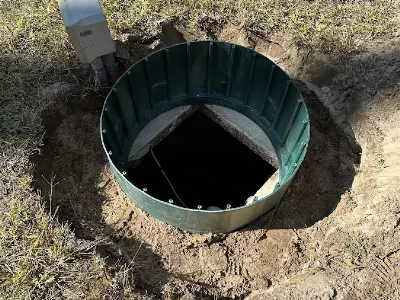
Since the 2023 amendments, all septic tanks, dosing tanks and holding tanks need at least one watertight riser extending to finish grade, which makes future access and pumping easier. Roof and foundation drains must not be connected to the system, and septic additives containing halogenated hydrocarbons are prohibited. No structure may sit on or over any part of the disposal system. Setbacks apply: the Rules require a 100-foot setback to a well, and a disposal area generally needs at least 60 feet from water unless a variance is approved.

3

Maine Septic Code

The septic code in Maine sets minimum soil conditions for disposal fields. Outside the shoreland area of major water bodies, a disposal field needs at least 9 inches to the seasonal groundwater table or restrictive horizon and at least 9 inches to bedrock. If less than 20 feet of suitable soil lies between the system and a waterbody or watercourse, the site is unacceptable for subsurface disposal and a holding tank becomes the only option under the Rules. Local Plumbing Inspectors apply these standards during permitting.

Key rules at a glance (11), with official sources
TopicRuleSource
Governing rule<cite index="3-1">The current rule is 10-144 CMR Chapter 241, effective 9/23/2023.</cite>maine.gov
Septic tank risers (2023 change)<cite index="3-3">Since the 2023 amendments, all septic tanks, dosing tanks and holding tanks need at least one watertight riser to finish grade.</cite>maine.gov
Permit trigger<cite index="15-3">A new, expanded or replacement system, or any individual component, needs a permit. Normal maintenance and repair are excepted.</cite>maine.gov
Inspection during installation<cite index="15-7">You must notify the Local Plumbing Inspector at least 24 hours before the system is ready for inspection.</cite> <cite index="15-2">The inspector does not have to inspect within 24 hours.</cite>maine.gov
Inspection at property sale<cite index="32-3">Since January 1, 2020, septic systems in any shoreland zone, not only the coastal one, must be inspected when the property is sold.</cite> <cite index="30-4,30-5">The buyer must have the system inspected by a Department-certified person before purchase. If weather makes that impossible, the inspection is due within 9 months after transfer. A malfunctioning system must be repaired or replaced within one year after transfer.</cite> <cite index="37-2">If the seller has a written inspection report from within 3 years before the transfer, the seller gives it to the buyer and the buyer need not re-inspect.</cite> I found no statewide inspection mandate for sales outside the shoreland zone.legislature.maine.gov
Setbacks and site limits (partial)<cite index="1-1,1-2">If there is less than 20 feet of suitable soil between the system and a waterbody or watercourse, the site is unacceptable for subsurface disposal. The only option under the Rules is then a holding tank.</cite> <cite index="1-4,1-6">A variance may be approved by the Local Plumbing Inspector if the disposal area is at least 60 feet from the water. If it is closer than 60 feet, Maine CDC must review the variance.</cite> <cite index="1-10">The Rules require a 100-foot setback to a well.</cite> I did not retrieve the full setback table for tanks and fields from an official source.maine.gov
Soil depth<cite index="7-5">Outside the shoreland area of major water bodies, a disposal field needs at least 9 inches to the seasonal groundwater table or restrictive horizon and at least 9 inches to bedrock.</cite>campmaine.com
Prohibited practices<cite index="9-6,9-9,9-11">Roof and foundation drains must not be connected to the system. Septic additives containing halogenated hydrocarbons are prohibited. No structure may be on or over any part of the disposal system.</cite>septicme.com
Pumping<cite index="39-1,39-5">Maine CDC advises pumping every two to five years depending on use, and every year if you use a garbage grinder.</cite> The only statement I found that there is no state-mandated pumping schedule comes from a non-official site (septictankhub.com), so treat it as unconfirmed.maine.gov
Finding your system records<cite index="16-4">To get a copy of your septic design (the HHE-200 form), ask the Town Office.</cite> <cite index="16-13">Maine CDC also offers a free septic permit search by address.</cite>maine.gov
Failing system<cite index="16-10,16-11">If a system is malfunctioning, pump the tank and keep it pumped until the system is replaced. You must also contact a licensed Site Evaluator to design the replacement.</cite>maine.gov

Official sources:Subsurface Wastewater Unit (Maine CDC)Maine Subsurface Wastewater Rules (Maine CDC)Subsurface Wastewater System Permitting (Maine CDC)Subsurface Wastewater Licensing & Certification (Maine CDC)Resources, Tips for Septic Systems, FAQs (Maine CDC)Subsurface Wastewater Program Policies (Maine CDC)

Rules change and some counties add their own. Check with your county health department before you start work.

Septic Tank permits and licenses in Maine

Installing or replacing a septic system in Maine requires a permit, and nothing may be installed until it is issued. A licensed Site Evaluator designs the system and prepares the HHE-200 application, after which you apply to your town's Local Plumbing Inspector for the installation permit, not to a county health department. Replacement tanks can use the HHE-200A form, which shows a minimum fee of $150, with the state keeping a 25% share of that amount. Fees for other systems vary by town. Notify the Local Plumbing Inspector at least 24 hours before the system is ready for inspection. To find existing records, ask your Town Office for the HHE-200 design, or use the free Maine CDC septic permit search by address.

How much does septic tank pumping cost in Maine?

Typical septic work in Maine lands in the same range as national averages, with the state typically a little lower. Septic tank pumping in Maine runs $285 to $550, with an average of $415, compared with $290 to $565 nationally (average $430). Septic tank installation averages $7,280 in the state, between $3,395 and $11,645, versus about $7,500 nationally. Replacement averages $6,310 in Maine, while drain field work averages $7,765. Repairs in Maine average $1,795, and inspections average $535. Actual quotes depend on tank size, access and soil conditions, so compare a few written estimates.

ServiceIn MaineNational
Septic Tank Pumping Cost $285 – $550 $290 – $565 -3%
Septic Tank Installation Cost $3,395 – $11,645 $3,500 – $12,000 -3%
Septic Tank Maintenance $290 – $485 $300 – $500 -3%
Septic Tank Inspection $195 – $875 $200 – $900 -3%
Septic Tank Replacement Cost $2,910 – $9,705 $3,000 – $10,000 -3%
Septic Tank Cost $280 – $550 $290 – $565 -3%
Septic Tank Cleaning Cost $290 – $680 $300 – $700 -3%
Septic Tank Repair Cost $630 – $2,910 $650 – $3,000 -3%
Drain Field $2,910 – $14,560 $3,000 – $15,000 -3%
Aerobic Septic System $195 – $580 $200 – $600 -3%

Typical ranges: national prices adjusted to the cost of living in Maine (BEA regional price parities). Your quote depends on your property.

Use the cost calculator

Septic Tank services in Maine: FAQ

Do I need a septic tank permit in Maine?

Yes. A new, expanded or replacement septic system, or any individual component, needs a permit from your town's Local Plumbing Inspector. Normal maintenance and repair are exempt, but nothing may be installed until the permit is issued.

Is a septic license required in Maine?

Site Evaluators must be licensed by the Maine CDC. The license costs $100 for 2 years and renews on March 1 of odd-numbered years, with 12 training hours required for renewal. Installer certification is described as voluntary on the official page, though certified installers may perform bottom-of-the-bed inspections for systems they installed.

How often should a septic tank be pumped in Maine?

Maine CDC advises pumping every two to five years depending on use, and every year if you use a garbage grinder. Keep the tank pumped if the system is malfunctioning until it can be replaced.

Get free quotes