Find your city

Type your city or ZIP code to see the best-rated septic service companies near you.

Get free quotes

Septic Tank Services in New Jersey

The best-rated septic service companies across New Jersey, plus state laws, permits and costs.

Looking for a septic tank New Jersey provider? This guide covers the most highly rated companies in the directory, the state rules that govern septic systems, and what homeowners typically pay. Septic work in New Jersey involves both state standards and local health department requirements, so knowing the basics helps you hire the right company and avoid costly surprises.

33 cities53 companiesavg. 4.7★

Top 10 septic service companies in New Jersey

The companies below are among the best-reviewed septic providers listed in the directory, spread across several New Jersey towns. Ratings and review counts reflect customer feedback, so compare a few options before you choose the one that fits your property and budget.

Show map

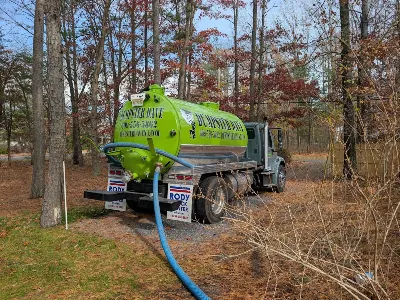
Dumpster Dave NJ

5.0 (103) Vineland, NJ 24/7

Customers value the same-day and after-hours responsiveness, plus the owner's personal involvement in answering calls and handling jobs. Reviewers also describe the work as honest and clearly explained, especially in emergencies.

  • Same-day service
  • Emergency sewage help
  • Owner-operated

Services:PumpingService

Contact See reviews Best in Vineland →

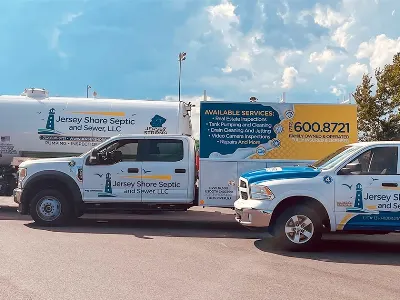
Jersey Shore Septic And Sewer LLC

5.0 (102) Lakewood, NJ

Customers appreciate the crew's prompt arrival, courteous manner, clean work, and fair pricing on jobs ranging from pumping to a tank decommissioning handled with permits. One reviewer, however, was unhappy that a promised full inspection was not completed and disputed how the team handled the pumping and driving equipment over the drain field.

  • Prompt response
  • Fair pricing
  • Permit handling

Services:PumpingInspectionServiceRepairReplacementDrain Field Services

Contact See reviews Best in Lakewood →

AAA Septic Service LLC

4.9 (49) Lakewood, NJ 24/7

Reviewers praise the family-owned team for their deep knowledge, including of unusual mound systems, and for fast help during late-night or urgent calls. Several describe the crew as friendly and easy to work with through full system replacements, with no recurring complaints.

  • Emergency response
  • Family owned
  • Mound systems

Services:PumpingCleaningInstallationReplacementServiceMaintenanceDrain Field Services

Contact See reviews Best in Lakewood →

Tiger Grease and Septic

4.9 (28) Clifton, NJ 24/7

Reviewers appreciate quick scheduling, reliable on-time arrivals, and clean, mess-free service for septic pumping and related jobs. Many also mention friendly communication from the office and technicians who answer questions in detail.

  • Septic pumping
  • Reliable scheduling
  • Clean service

Services:PumpingServiceCleaning

Contact See reviews Best in Clifton →

Russell Reid Waste Management

4.6 (59) New Brunswick, NJ

Customers appreciate professional crews, helpful maintenance tips, and quick scheduling for routine pumping and tank work. The most common complaint is that final invoices came in higher than the quoted price, and one customer felt emergency calls went unanswered after the company took over another provider's accounts.

  • Professional crews
  • Prompt scheduling
  • Billing disputes

Services:PumpingMaintenanceCleaning

Contact See reviews Best in New Brunswick →

New Jersey Septic Tank Laws & Requirements

New Jersey septic systems are regulated by a combination of state rules and local enforcement. Understanding who sets the standards and who approves your work will help you know what to expect before any repair, installation or sale of a home with a septic system.

Who regulates it New Jersey Department of Environmental Protection (NJDEP), Division of Water Quality, Onsite Wastewater Management Program, working with local health departments

Septic systems of 2,000 gallons per day or less are regulated under N.J.A.C. 7:9A and fall under local administrative authorities, meaning health departments. NJDEP sets the standards, and municipal and county Boards of Health implement and enforce them, usually through contracted local health departments.

1

New Jersey Septic Tank Laws

Septic systems serving 2,000 gallons per day or less are regulated under N.J.A.C. 7:9A. The New Jersey Department of Environmental Protection (NJDEP), through its Division of Water Quality and Onsite Wastewater Management Program, sets the standards. Local health departments, usually municipal or county Boards of Health, carry out and enforce those standards. Unless your local health department directs otherwise, you generally do not need NJDEP approval to repair, alter or construct your system. Work on a septic system without the required permits is prohibited, and a system cannot be approved where a sanitary sewer line is available within 100 feet of the property.

2

New Jersey Septic Tank Requirements

The rules set minimum distances for septic components. Under the state code, a septic tank must be 50 feet from a well or suction line, 10 feet from a water service line, 25 feet from a watercourse, 10 feet from an occupied building, 5 feet from a property line and 10 feet from an in-ground pool. Local authorities can require greater distances where soils are very coarse or rock is fractured. Basement floor, footing and roof drainage must stay out of the system, and no restricted chemical cleaner may be introduced. NJDEP recommends having the tank pumped completely at least every three years by a licensed septic hauler and keeping the records.

3

New Jersey Septic Code

The New Jersey septic code, N.J.A.C. 7:9A, covers location, design, construction, installation, repair and operation of onsite systems. Systems with a design flow above 2,000 gallons per day fall under different permits, including N.J.A.C. 7:14A or Discharge to Ground Water permits. Alternative designs that do not strictly conform to the code may require an Alternative Design Treatment Works Approval from NJDEP. Local rules can add requirements, so check with your municipality before starting work. NJDEP has also warned that unsecured tank covers can cause serious injury, so keep covers locked or secured.

Key rules at a glance (15), with official sources
TopicRuleSource
Who regulates<cite index="2-2,2-3,2-4">Septic location, design, construction, installation, repair and operation are governed by N.J.A.C. 7:9A, under the Realty Improvement Sewerage and Facilities Act (N.J.S.A. 58:11-23).</cite>dep.nj.gov
Local approval vs. state approval<cite index="2-9">Unless a local health department directs otherwise, residents do not need NJDEP approval to repair, alter or construct their septic system.</cite>dep.nj.gov
Work without permit prohibited<cite index="4-2">No one may install, construct, alter or repair a septic system without first getting the permits, approvals or certifications the chapter requires.</cite>law.cornell.edu
Sewer availability<cite index="4-4">The administrative authority cannot approve construction or alteration of a septic system where a sanitary sewer line is available within 100 feet of the property.</cite>law.cornell.edu
Inspection at property sale<cite index="22-2,22-3">Per Salem County Health, the state septic code does not require a septic system to be certified or inspected in a real estate transaction, but it sets minimum requirements for a 'state recognized inspection'.</cite> <cite index="11-3">Local rules can be stricter: Hopewell Township, for example, requires approval of onsite septic and/or well water quality for any transfer of property.</cite>health.salemcountynj.gov
Local sale/rental rules example<cite index="11-1,11-10">Hopewell Township requires a third-party inspection following NJDEP procedures, and rentals require a tank pump-out after each change of occupancy.</cite>hopewelltwp.org
Setbacks - septic tankPer Table 4.3 of N.J.A.C. 7:9A-4.3, <cite index="37-5">a septic tank must be 50 ft from a well or suction line, 10 ft from a water service line, 25 ft from a water course, 10 ft from an occupied building, 5 ft from a property line, and 10 ft from an in-ground pool; the administrative authority may increase these distances where soils are very coarse or the rock is fractured.</cite>law.cornell.edu
Setbacks - seepage pit<cite index="37-13">A seepage pit must be 150 feet from a well and 100 feet from a suction line.</cite> I did not verify the disposal-field-to-well distance from an official source; non-official sites give conflicting figures.law.cornell.edu
Pumping/maintenance<cite index="38-1,38-6">NJDEP's homeowner guide recommends inspecting and pumping every three years, with pumping generally every three to five years depending on use and tank size</cite>; this is a recommendation, and I found no statewide pumping mandate.dep.nj.gov
Pumping by licensed hauler<cite index="39-11">NJDEP recommends pumping the tank out completely at least every 3 years using a licensed septic hauler, and keeping the pumping records.</cite>southbrunswicknj.gov
What can go in the system<cite index="8-4">Basement floor, footing and roof drainage must not enter the system.</cite> <cite index="8-6">No one may introduce any sewage system cleaner containing a restricted chemical material.</cite>regulations.justia.com
Holding tanks<cite index="7-5">The administrative authority may approve a sewage holding tank in place of a septic system only as a temporary measure, for a period not to exceed 180 days, under certain conditions.</cite>capemaycountynj.gov
Approved tanks/designI did not find an official 'approved septic tank' list in the sources reviewed. Tank construction is covered by N.J.A.C. 7:9A-8.2, and <cite index="3-10,3-11,3-12">NJDEP's Onsite Wastewater Management Program can issue an Alternative Design Treatment Works Approval when a system does not strictly conform to 7:9A.</cite>dep.nj.gov
Large systems<cite index="3-7,3-8">Systems over 2,000 gpd are permitted under N.J.A.C. 7:14A or through Discharge to Ground Water permits.</cite> <cite index="9-1">Systems covered include those that, once all improvements are complete, would exceed 2,000 gpd.</cite>dep.nj.gov
Tank cover safety (NJ-specific)NJDEP enforcement advisory 2022-05 warns that <cite index="46-3">unsecured septic tank covers may result in physical harm or death</cite>, and urges owners to keep covers secure.nj.gov

Official sources:NJDEP Division of Water Quality - Septic SystemsNJDEP - Septic Professional InformationNJDEP - Septic Permitting InformationN.J.A.C. 7:9A courtesy copy (NJDEP)N.J.A.C. 7:9A-1.6 General prohibitions (Cornell LII)N.J.A.C. 7:9A-4.3 Distances (Cornell LII)

Rules change and some counties add their own. Check with your county health department before you start work.

Septic Tank permits and licenses in New Jersey

A septic permit is required before a system is located, designed, constructed, installed, altered or operated under N.J.A.C. 7:9A. Your local Board of Health handles plan review and permit issuance, and fees and forms vary by county and municipality. If your project does not conform to the standard code, you may need an NJDEP Alternative Design Treatment Works Approval. Ask your septic contractor who will file the paperwork and whether the permit is needed before work begins, since starting without one is not allowed.

How much does septic tank pumping cost in New Jersey?

In New Jersey, septic tank pumping typically runs $320 to $615, with an average near $465. Nationally, the typical range is $290 to $565, averaging about $430, so pumping in the state tends to cost somewhat more. Installation is also higher in New Jersey, with an average of about $8,160 compared with $7,500 nationally. Replacement averages $7,070 in the state versus $6,500 nationally, and drain field work averages about $8,705 versus $8,000. Get quotes from more than one provider to compare.

ServiceIn New JerseyNational
Septic Tank Pumping Cost $320 – $615 $290 – $565 +8%
Septic Tank Installation Cost $3,810 – $13,055 $3,500 – $12,000 +9%
Septic Tank Maintenance $325 – $545 $300 – $500 +9%
Septic Tank Inspection $220 – $980 $200 – $900 +9%
Septic Tank Replacement Cost $3,265 – $10,880 $3,000 – $10,000 +9%
Septic Tank Cost $315 – $615 $290 – $565 +8%
Septic Tank Cleaning Cost $325 – $760 $300 – $700 +8%
Septic Tank Repair Cost $705 – $3,265 $650 – $3,000 +9%
Drain Field $3,265 – $16,320 $3,000 – $15,000 +9%
Aerobic Septic System $220 – $655 $200 – $600 +9%

Typical ranges: national prices adjusted to the cost of living in New Jersey (BEA regional price parities). Your quote depends on your property.

Use the cost calculator

Septic Tank services in New Jersey: FAQ

Do I need a septic tank permit in New Jersey?

Yes. N.J.A.C. 7:9A requires a permit before a septic system is located, designed, constructed, installed, altered or operated. Your local Board of Health usually handles the permit, and your contractor can tell you what paperwork is needed for your project.

Is a septic license required in New Jersey?

The state does not generally license septic installers or real estate transfer inspectors, except for advanced treatment systems. Some towns add their own licensing rules, such as requiring a licensed installer for permits, so check your local health department.

How often should a septic tank be pumped in New Jersey?

NJDEP recommends having the tank pumped completely at least every three years by a licensed septic hauler. Keep records of each pumping, since they can be useful when you sell the property or deal with local inspections.

Get free quotes