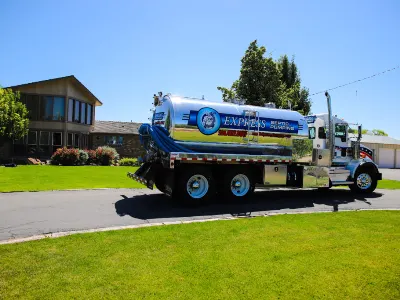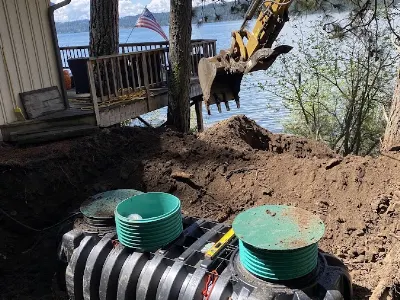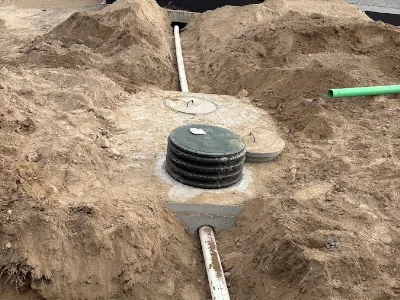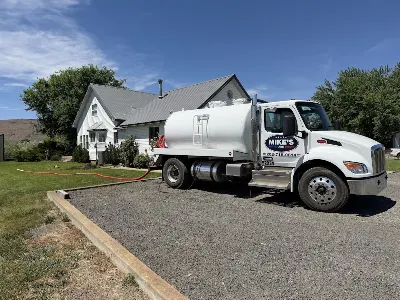
Customers consistently praise the technicians for arriving on time, communicating clearly, and explaining the system in plain terms. Pricing is described as fair, and no recurring complaints appear.
- On-time arrivals
- Clear explanations
- Fair pricing
Type your city or ZIP code to see the best-rated septic service companies near you.
The best-rated septic service companies across Idaho, plus state laws, permits and costs.
Looking for a septic tank Idaho service? This guide lists well-rated septic companies across the state, explains how Idaho regulates septic systems, and shows typical costs. Rules are set by the Idaho Department of Environmental Quality, while public health districts issue permits and inspect work locally. Prices below come from state and national ranges, so you can judge quotes before you hire.
12 cities32 companiesavg. 4.9★
The companies below are among the highest-rated septic providers in Idaho. Ratings and review counts reflect each business's own listing, so compare several before choosing one for your property.
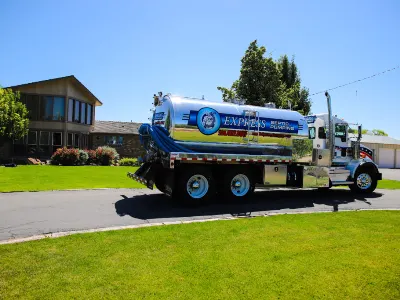
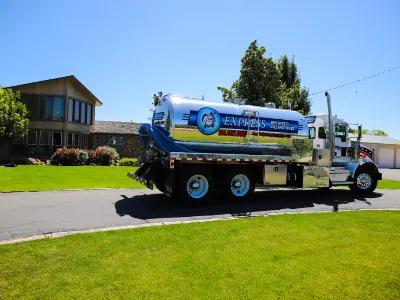
Customers consistently praise the technicians for arriving on time, communicating clearly, and explaining the system in plain terms. Pricing is described as fair, and no recurring complaints appear.
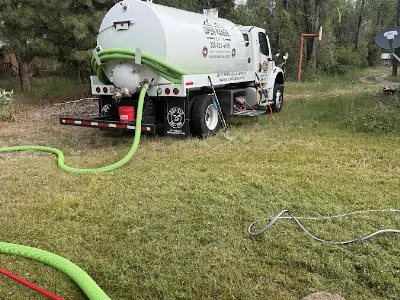
Reviewers value the friendly, patient technicians who walk them through the pumping process and suggest ongoing care between visits. Scheduling and updates are described as easy and well communicated.
Services:PumpingInspectionMaintenanceService
Customers consistently praise the team's deep knowledge of older and complex septic systems and their willingness to answer questions and fix problems quickly, including emergencies. Reviewers also describe the crew as honest and reliable on large, costly jobs. No recurring complaints appear in the written feedback.
Services:CleaningInspectionRepairPumpingMaintenanceServiceRiser InstallationDrain Field ServicesInstallation
Customers consistently praise the owner's professionalism, punctuality, and clear communication, especially when he explains routine upkeep and flags small issues. Fair pricing and quick, same-day scheduling come up often, and no recurring complaints appear.
Services:ServiceCleaningMaintenancePumping
Customers appreciate the owners' honesty about extra costs, quick scheduling, and reasonable prices. Reviewers also say the crew explains what the septic system needs and does careful, friendly work.
Customers praise the technicians for being professional, on time, and good communicators, with emailed inspection reports that include photos. One recurring complaint is that the billing department sent overdue payment notices and calls very soon after the job was finished.
Services:PumpingMaintenanceInspection
Customers praise technicians who walk them through septic tank emptying and give honest recommendations without pushing unnecessary work. One reviewer felt a response was slower than expected, though the work was done properly.
Customers highlight fast response times, courteous and efficient technicians, and clear explanations of the work. Several say the team handled more involved jobs, such as installing a riser and a new baffle, well.
Reviewers highlight professional, respectful crews who arrive on time, tidy up after the job, and pay close attention to detail. Several mention quick scheduling and that they were glad to keep the company for future septic needs.
Customers value the thorough, honest work and the way the team keeps them informed, including handling permits and inspections for a drain field replacement. Reviewers also describe the pricing as fair and the staff as responsive, including for after-hours emergencies.
Septic providers are spread across Idaho, from Caldwell and Meridian in the southwest to Coeur d'Alene in the north and Idaho Falls in the east.
Septic systems in Idaho are governed by a single statewide set of rules, applied locally by public health districts. Understanding who does what helps you plan an installation, repair or pumping job without delays.
Septic systems in Idaho are governed statewide by DEQ's rules at IDAPA 58.01.03, "Individual/Subsurface Sewage Disposal Rules and Rules for Cleaning of Septic Tanks." Public health districts apply those rules locally: they evaluate sites, issue permits, inspect installations and license installers and pumpers. Idaho has no statewide pumping schedule or statewide septic inspection at sale, but some districts and lenders add requirements.
Idaho septic systems are governed statewide by the Idaho Department of Environmental Quality (DEQ) under IDAPA 58.01.03, the rules for individual and subsurface sewage disposal and for cleaning septic tanks. The rules apply to every individual and every subsurface blackwaste and wastewater treatment system in the state. Idaho has no statewide pumping schedule or statewide inspection at property sale, though some districts and lenders add their own requirements. Check with your local district before a sale or major project.
Public health districts carry out the DEQ rules. They evaluate sites, issue permits, inspect installations and license installers and pumpers. A permit is required for all new onsite systems, for replacement disposal systems, and for replacing or adding a tank. Repairing a clogged or broken system does not appear to need a new permit, but confirm the exact wording with your district. Setback distances also apply: the septic tank must sit at least 50 feet from most wells and 5 feet from a property line, while the drainfield needs a designated replacement area.
The septic code in IDAPA 58.01.03 sets minimum distances from water sources, foundations and property lines, and requires a replacement area for the drainfield. Pumping, transporting and disposing of septage requires a permit from any health district, and an inspector checks the equipment before issuing it. Installers must be licensed, and a basic or complex license requires passing the DEQ exam and posting a bond. Discharging pollutants from a septic system except as the rules allow is prohibited.
| Topic | Rule | Source |
|---|---|---|
| Who regulates | <cite index="9-3,9-4">Septic systems are regulated by DEQ's Rules for Individual and Subsurface Sewage Disposal Systems.</cite> <cite index="9-5,9-10">Health districts issue permits for all new and repaired systems and inspect on-site systems for compliance.</cite> | idahopublichealth.com |
| Scope of the rule | <cite index="3-6">IDAPA 58.01.03 applies to every individual and every subsurface blackwaste and wastewater treatment system in Idaho.</cite> | www2.deq.idaho.gov |
| When a permit is needed | <cite index="25-8,25-9,25-10">All new onsite systems need a permit. Replacement disposal systems need a replacement permit. Replacing an existing septic tank or adding another tank also needs a permit.</cite> <cite index="25-12">You do not need a permit to fix a clogged or broken system.</cite> The source text cuts off before saying what exactly is exempt, so check the exact wording with your district. | idahopublichealth.com |
| Site evaluation | <cite index="24-4,24-5">The property owner must get a permit from a public health district to have a septic system installed. DEQ advises having the district and a licensed installer evaluate the site before buying the property or applying for a permit.</cite> | deq.idaho.gov |
| Permit fees (example, varies by district) | A health district training document says the statewide sewage permit application fee is $1,100, paid upfront, with $650 refunded if the site is denied. It also lists a $450 speculative site evaluation fee, valid for one year and credited toward the permit if submitted within that year. These fees come from one district's training document, so confirm current fees with your own district. | idahopublichealth.com |
| Installation inspection | <cite index="29-1">Systems should be installed by a licensed installer and inspected by your local health district.</cite> A non-official summary says the final inspection must happen before the system is buried (secondary source). | cdh.idaho.gov |
| Inspection at property sale | I found no official source requiring a septic inspection at sale. Secondary sources say <cite index="31-4,31-6">Idaho has no statewide time-of-transfer inspection requirement, but Panhandle Health District is reported to require a sewage system evaluation at property transfer.</cite> <cite index="33-5">Many lenders, including FHA and VA loans, require one.</cite> Confirm with the district. | septicseeker.com |
| Setbacks: well | <cite index="42-1">The current IDAPA 58.01.03 table requires a septic tank to be at least 100 feet from a public-water well and 50 feet from other wells.</cite> A health district summary lists the <cite index="44-7">drainfield at 100 feet from all wells and the septic tank at 50 feet from all wells.</cite> The well-construction rule separately requires <cite index="40-4">100 feet from a septic drain field and 50 feet from a septic tank.</cite> | adminrules.idaho.gov |
| Setbacks: tank | <cite index="42-1">Septic tank minimum distances are 50 feet from permanent or intermittent surface water, 25 feet from temporary surface water, 5 feet from a dwelling foundation and 5 feet from a property line.</cite> | adminrules.idaho.gov |
| Setbacks: drainfield | <cite index="44-7">A health district overview lists the drainfield at 10 feet from a foundation (20 feet from a basement), 5 feet from property lines, and 6 feet from the tank.</cite> <cite index="44-6">It also lists 50 feet from temporary surface water such as ditches and canals, and 100, 200 or 300 feet from streams, lakes or rivers depending on soil type.</cite> | siphidaho.org |
| Replacement area | <cite index="44-7">A designated replacement area for the drainfield that meets all setback distances is required.</cite> | siphidaho.org |
| Pumping and maintenance | I found no official statewide pumping schedule. The DEQ pumpers manual says tanks should be pumped before they reach the sludge or scum limits it defines, and <cite index="29-12">the Central District Health homeowner guide suggests pumping every three years or as your inspections indicate.</cite> <cite index="21-1">Pumping should be done by a permitted pumper.</cite> | cdh.idaho.gov |
| Pumper permits | <cite index="21-2,21-4">A permit is required throughout Idaho for pumping, transporting and disposing of septage, and it can be obtained from any health district.</cite> <cite index="21-4">A health district inspector checks the tank trucks and equipment before issuing the permit.</cite> The older rule (IDAPA 58.01.15) said <cite index="22-4">permits are renewed annually.</cite> | www2.deq.idaho.gov |
| Failing systems | <cite index="11-11">No person may discharge pollutants into waters through an individual or subsurface sewage disposal system except as these rules allow.</cite> <cite index="15-12,15-13">An earlier version of the rule made a violation a misdemeanor.</cite> I did not confirm whether the current version keeps that wording. | adminrules.idaho.gov |
Official sources:Idaho DEQ – Septic and SeptageIDAPA 58.01.03 (current) – Individual/Subsurface Sewage Disposal RulesDEQ – Idaho Septic Pumpers Technical Guidance Manual (Aug 2025)DEQ – Technical Guidance Manual for Individual and Subsurface Sewage DisposalSouthwest District Health – Septic & Land DevelopmentPublic Health Idaho North Central District – Septic Systems
Rules change and some counties add their own. Check with your county health department before you start work.
To install a new septic system in Idaho, you apply to your public health district, which evaluates the site and issues the subsurface sewage disposal permit. The same process applies to replacement systems and to replacing or adding a tank. Application fees differ by district; one district's training material lists a $1,100 application fee and a $450 speculative site evaluation fee, but confirm current fees with your own district before you apply. A licensed installer should be involved from the start, and the installation must be inspected before it is buried.
Typical Idaho septic costs run close to national averages. Septic tank pumping in Idaho ranges from $280 to $540, averaging $410, compared with a national range of $290 to $565 and an average of $430. Septic tank installation averages $7,160 in Idaho, between $3,340 and $11,460, against a national average of $7,500. Repairs average $1,765 in the state, and drain field work averages $7,640. Prices vary with tank size, soil and access, so treat these figures as ranges rather than fixed quotes.
| Service | In Idaho | National | |
|---|---|---|---|
| Septic Tank Pumping Cost | $280 – $540 | $290 – $565 | -5% |
| Septic Tank Installation Cost | $3,340 – $11,460 | $3,500 – $12,000 | -5% |
| Septic Tank Maintenance | $285 – $475 | $300 – $500 | -5% |
| Septic Tank Inspection | $190 – $860 | $200 – $900 | -5% |
| Septic Tank Replacement Cost | $2,865 – $9,550 | $3,000 – $10,000 | -5% |
| Septic Tank Cost | $275 – $540 | $290 – $565 | -5% |
| Septic Tank Cleaning Cost | $285 – $670 | $300 – $700 | -5% |
| Septic Tank Repair Cost | $620 – $2,865 | $650 – $3,000 | -5% |
| Drain Field | $2,865 – $14,325 | $3,000 – $15,000 | -5% |
| Aerobic Septic System | $190 – $575 | $200 – $600 | -5% |
Typical ranges: national prices adjusted to the cost of living in Idaho (BEA regional price parities). Your quote depends on your property.
Use the cost calculatorYes, for new systems, replacement disposal systems, and for replacing or adding a septic tank. Apply to your local public health district, which evaluates the site and issues the permit. Repairs to a clogged or broken system generally do not require a new permit, but check with your district.
Septic systems must be installed by a licensed basic or complex installer, unless a homeowner installs a standard or basic system on their own property without hired help. Installer licenses require passing the DEQ exam, applying through the health district, and posting a bond of $10,000 for basic or $30,000 for complex. Pumpers hold a separate permit from the health district.
Pumping in Idaho typically runs $280 to $540, and installation averages about $7,160. Costs are close to national averages, but final prices depend on tank size, soil conditions and site access. Get a quote from a licensed provider before scheduling work.
AlabamaAlaskaArizonaArkansasCaliforniaColoradoConnecticutDelawareDistrict of ColumbiaFloridaGeorgiaHawaiiIllinoisIndianaIowaKansasKentuckyLouisianaMaineMarylandMassachusettsMichiganMinnesotaMississippiMissouriMontanaNebraskaNevadaNew HampshireNew JerseyNew MexicoNew YorkNorth CarolinaNorth DakotaOhioOklahomaOregonPennsylvaniaRhode IslandSouth CarolinaSouth DakotaTennesseeTexasUtahVermontVirginiaWashingtonWest VirginiaWisconsinWyoming