Find your city

Type your city or ZIP code to see the best-rated septic service companies near you.

Get free quotes

Septic Tank Services in Kentucky

The best-rated septic service companies across Kentucky, plus state laws, permits and costs.

Looking for a septic tank Kentucky provider? This guide covers how septic work is regulated in the state, what permits and licenses apply, what you can expect to pay, and which local companies have strong ratings. Most homeowners deal with pumping, inspection or repair, and knowing the rules first helps you choose the right provider.

13 cities37 companiesavg. 4.8★

Top 10 septic service companies in Kentucky

The companies below are some of the highest-rated septic providers listed across Kentucky. Ratings and review counts come from their directory profiles, so compare a few options before choosing.

Show map

A & A Sanitation

5.0 (67) Richmond, KY 24/7

Customers describe the technicians as courteous, punctual, and happy to explain how septic systems work. Several mention fast scheduling and a willingness to help on weekends and emergencies, including repairing a failed grinder pump.

  • Weekend emergencies
  • Friendly technicians
  • Quick scheduling

Services:PumpingServiceRepair

Contact See reviews Best in Richmond →

G D Estes & Co

4.9 (137) Louisville, KY 24/7

Customers consistently praise the courteous, patient technicians and the office team's flexibility with scheduling, including same-day help for urgent needs. People also appreciate the simple booking process, advance call before arrival, and a waived emergency call fee.

  • Same-day help
  • Courteous technicians
  • Easy scheduling

Services:PumpingServiceMaintenance

Contact See reviews Best in Louisville →

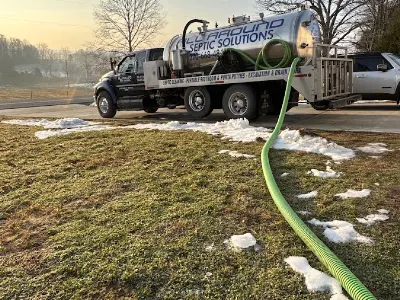
All Around Septic Solutions

5.0 (25) Elizabethtown, KY 24/7

Customers appreciate how quickly this team arrives, often the same or next day, and how courteous and careful the technicians are with driveways and yards. Inspection reports are described as detailed and clear, which buyers find especially useful. No recurring complaints stood out.

  • Fast response
  • Detailed inspections
  • Careful on-site work

Services:PumpingCleaningInspectionRepairServiceMaintenance

Contact See reviews Best in Elizabethtown →

Septic Service Companies by city in Kentucky

Septic providers are spread across the state, with listings in several cities. Choose a company near your property so scheduled pumping and emergency calls are easier to arrange.

Kentucky Septic Tank Laws & Requirements

Septic work in Kentucky follows a set of state regulations enforced largely through local health departments. Knowing the basics will help you ask the right questions before any work starts on your system.

Who regulates it Kentucky Cabinet for Health and Family Services, Department for Public Health, Environmental Management Branch (Onsite Sewage Disposal Systems Program), working through local health departments

<cite index='2-2'>Kentucky regulates the construction, installation, or alteration of on-site sewage systems under KRS 211.180(1)(d) and 902 KAR 10:085.</cite> <cite index='12-2'>Local health department inspectors do the site evaluations and inspections.</cite>

1

Kentucky Septic Tank Laws

The Kentucky Cabinet for Health and Family Services, Department for Public Health, Environmental Management Branch (Onsite Sewage Disposal Systems Program) oversees on-site sewage systems, working through local health departments. Construction, installation and alteration of these systems are regulated under KRS 211.180(1)(d) and 902 KAR 10:085. Local health department inspectors carry out site evaluations and inspections, so your county office is usually the first point of contact for questions about your system.

2

Kentucky Septic Tank Requirements

Several regulations apply together. 902 KAR 10:081 covers component standards, 10:085 covers system rules, 10:110 covers permits, 10:140 covers installer certification, and 10:170 covers septic tank servicing. Key distance rules include a minimum of 5 feet from property lines and 10 feet from building foundations, and new wells should be at least 50 feet from a septic tank. Owners are responsible for protecting the system and for its operation and maintenance.

3

Kentucky Septic Code

The state septic code is built around the onsite evaluation of soil and site conditions, followed by permitting and inspection before and after installation. Trench or bed depth from grade may not exceed 24 inches, and conventional systems must keep at least 18 inches between trench bottoms and rock, the water table or a restrictive horizon. Pumpers must hold an annual business license, and operators may not use chemical or biological additives unless the cabinet has approved them.

Key rules at a glance (17), with official sources
TopicRuleSource
Who regulates<cite index='10-9'>The program is administered through local health departments and starts with an onsite evaluation of site and soil conditions.</cite>eec.ky.gov
Core regulations<cite index='21-4,12-2'>The key rules are 902 KAR 10:081 (component standards), 10:085 (system rules), 10:110 (permits), 10:140 (installer certification) and 10:170 (septic tank servicing).</cite>chfs.ky.gov
Permit before construction<cite index='2-4'>After the site evaluation, a permit must be obtained before any part of the system is constructed, installed, or altered.</cite>apps.legislature.ky.gov
Installation inspection<cite index='5-6'>Every on-site system that is installed, constructed, altered, or repaired must be inspected.</cite> The regulation text I retrieved was cut off, so I could not confirm who performs the inspection.healthdepartment.org
Setbacks (state table)<cite index='43-6'>Table 7 sets a minimum of 5 feet from property lines, 10 feet from building foundations, and 20 feet from basements and cemeteries, measured from the pretreatment unit or the lateral trench or bed sidewall.</cite> The remaining table rows (wells, streams and others) were not fully retrieved.apps.legislature.ky.gov
Setback from new wells<cite index='44-8'>A state Energy and Environment Cabinet fact sheet says to locate new wells at least 50 feet from a septic tank and 70 feet from the lateral field, citing 902 KAR 10:085.</cite>eec.ky.gov
Trench depth and water table<cite index='1-1'>The maximum trench or bed depth from grade is 24 inches.</cite> <cite index='39-3'>Conventional and other approved systems must keep at least 18 inches between trench bottoms and rock, water table, or a restrictive horizon.</cite>law.cornell.edu
Owner responsibility<cite index='1-9'>During occupancy the owner must protect the system from damage, disruption, or unnecessary surface water drainage.</cite> <cite index='1-11'>Operation and maintenance are the responsibility of the owner, developer, certified installer, or user, as applicable.</cite>law.cornell.edu
Repair or alteration<cite index='1-12'>Repair or alteration of an on-site system is permitted if a municipal or public sewage system is not available (and other conditions apply that I did not retrieve).</cite>law.cornell.edu
Pumping frequencyI found no state-mandated pumping interval for homeowners. <cite index='33-14'>A state groundwater-protection guide advises contacting a pumper if the tank was last pumped over three years ago or if you don't know when it was last pumped.</cite>eec.ky.gov
Pumper (septic tank servicing) rules<cite index='30-5'>902 KAR 10:170 requires an annual business license to service septic tanks and similar systems, and operators must remove all domestic septage from the tank.</cite> <cite index='36-9'>Operators may not use chemical or biological cleaners or additives unless the cabinet has approved them.</cite> <cite index='30-6'>Operators must also notify the owner of any damage they find.</cite>apps.legislature.ky.gov
Pumper licensing locally<cite index='31-2,31-3'>In Fayette County, sewage pump trucks are inspected annually, and the Health Department processes and issues the state licenses.</cite>lfchd.org
Sale / transfer inspectionI found no official source with a statewide septic inspection requirement at property sale. A non-official site says <cite index='24-5'>there is no statewide mandate for inspections at property transfer.</cite> Local health departments do offer existing-system inspections (for example <cite index='27-12'>Lincoln Trail District Health Department</cite>), so check with your county.ltdhd.org
Homeowner self-install<cite index='21-3'>A homeowner who wants to install their own system must get a homeowner's permit from the local health department.</cite>chfs.ky.gov
Complaints<cite index='12-3'>Complaints about a septic system, installer, or pumper go to the local health department.</cite>chfs.ky.gov
Local variation and feesFees and process details are set locally. <cite index='26-12'>Each county health department sets its own fee schedule and process details within the state's baseline requirements</cite> (non-official source). Check your county's fee chart, such as the one published by <cite index='37-13'>Lincoln Trail District Health Department</cite>, which requires fees to be paid before services.ltdhd.org
Approved tanks / componentsComponent standards are in 902 KAR 10:081, which I did not retrieve in full, so I have no approved-tank list. <cite index='5-6'>Treatment units must meet 902 KAR 10:081 minimums and be approved for use in Kentucky.</cite> Ask your local health department which tank models are accepted.healthdepartment.org

Official sources:Onsite Sewage Disposal Systems Program - CHFS902 KAR 10:085 - Kentucky on-site sewage disposal systems (LRC)902 KAR 10:085 (Cornell LII)902 KAR 10:140 Installer certification program standards (LRC)902 KAR 10:170 Septic tank servicing (LRC)CHFS Septic Installer Training Opportunities

Rules change and some counties add their own. Check with your county health department before you start work.

Septic Tank permits and licenses in Kentucky

A permit from your local health department is required before any part of an on-site system is built, installed or altered. The process begins with a site evaluation of soil and site conditions, and if the site is rated suitable or provisionally suitable, the certified installer applies for the permit and submits the paperwork and fee. Homeowners who plan to install their own system need a homeowner's permit from the same office. Fees and process details vary by county, so check your local health department before scheduling work.

How much does septic tank pumping cost in Kentucky?

Typical septic work in Kentucky is often priced somewhat below national averages. Pumping usually runs $265 to $510 in the state, with an average of $385, compared with $290 to $565 nationally. Installation averages $6,760 in Kentucky against a national average of $7,500, and replacement averages $5,860 versus $6,500 nationally. Repairs typically fall between $585 and $2,705 in the state, while drain field work averages $7,215 locally compared with $8,000 nationally.

ServiceIn KentuckyNational
Septic Tank Pumping Cost $265 – $510 $290 – $565 -10%
Septic Tank Installation Cost $3,155 – $10,820 $3,500 – $12,000 -10%
Septic Tank Maintenance $270 – $450 $300 – $500 -10%
Septic Tank Inspection $180 – $810 $200 – $900 -10%
Septic Tank Replacement Cost $2,705 – $9,015 $3,000 – $10,000 -10%
Septic Tank Cost $260 – $510 $290 – $565 -10%
Septic Tank Cleaning Cost $270 – $630 $300 – $700 -10%
Septic Tank Repair Cost $585 – $2,705 $650 – $3,000 -10%
Drain Field $2,705 – $13,525 $3,000 – $15,000 -10%
Aerobic Septic System $180 – $540 $200 – $600 -10%

Typical ranges: national prices adjusted to the cost of living in Kentucky (BEA regional price parities). Your quote depends on your property.

Use the cost calculator

Septic Tank services in Kentucky: FAQ

Do I need a septic tank permit in Kentucky?

Yes. A permit from your local health department is required before any part of a system is built, installed or altered. Homeowners installing their own system need a homeowner's permit from the same office.

Is a septic license required in Kentucky?

Installers must be certified under the state program, and the exam is given through the local health department. Septic tank pumpers hold a separate annual business license under 902 KAR 10:170.

How much does septic tank pumping cost in Kentucky?

Pumping typically costs $265 to $510, with an average of $385 across the state. That is slightly below the national average of $430, though prices depend on tank size and location.

Get free quotes