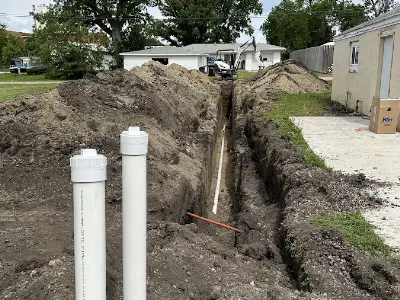
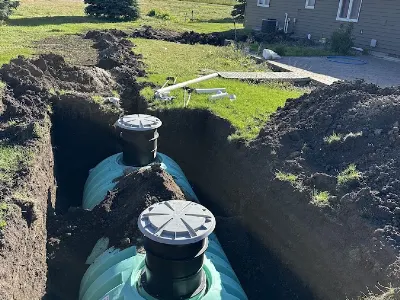
| Who regulates | <cite index='14-4'>The 2003 Private Onsite Wastewater Treatment System Contractors Certification and System Registration Act requires anyone doing onsite wastewater work to be certified, and the rules are in Title 124.</cite> | dwee.nebraska.gov |
| Registration | <cite index='12-3,12-4'>Construction or modification of an onsite system must be registered with the state, at $140 per system.</cite> | dwee.nebraska.gov |
| Installer responsibility for registration | <cite index='18-11'>The installer is responsible for registering the system, whether it is installed under 'authorization by rule' or under a construction permit.</cite> | dee.ne.gov |
| When a state permit is needed | <cite index='20-1'>A state permit is required when the domestic design flow is over 1,000 gallons per day, the flow includes non-domestic wastewater, or the system may endanger health or cause pollution.</cite> <cite index='20-1'>A permit is also required when the system can't meet Title 124 design or setback rules, including percolation slower than 60 minutes per inch, less than 4 ft from trench bottom to groundwater, or a household lagoon on a lot under 3 acres.</cite> | dee.ne.gov |
| No homeowner exemption | <cite index='29-4,29-5'>Only a certified professional, a professional engineer, a registered environmental health specialist, or a person under their direct supervision may inspect, pump, site, build, alter, repair or close a system. There is no homeowner exemption.</cite> | dee.ne.gov |
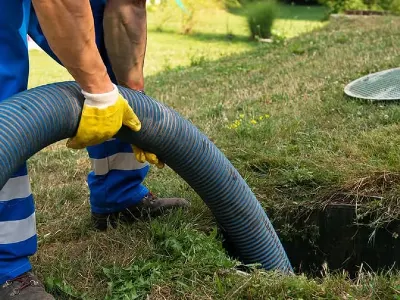
| Pumping/maintenance | <cite index='9-5'>A Master or Journeyman Pumper, professional engineer, or registered environmental health specialist must periodically inspect the tank and remove septage when the sludge top is less than 12 inches below the bottom of the outlet baffle, or the scum bottom is less than 3 inches above it.</cite> I found no fixed statewide pumping interval in the official sources. | dwee.nebraska.gov |
| Setbacks – foundations | <cite index='23-5,23-6'>Under Title 124 Table 2.1, tanks may not be placed within 25 ft of a Class 1 foundation, 20 ft of a Class 2 foundation, or 15 ft of a Class 3 foundation, unless the department reviews the site and issues a construction permit.</cite> | dwee.nebraska.gov |
| Setbacks – wells | <cite index='21-6'>An Extension (non-state-agency) source says a septic tank must be at least 50 ft, and a leach field at least 100 ft, from a private drinking water well.</cite> <cite index='23-7'>Water well rules in Titles 178 and 179 may require greater distances.</cite> | drinking-water.extension.org |
| Setbacks – protecting them afterward | <cite index='22-6'>No one may build or relocate a foundation, well, water line, surface water feature or property line within the Table 2.1 setbacks of any onsite system, unless the department approves an encroachment at the owner's request.</cite> | dwee.nebraska.gov |
| Lot size | <cite index='7-4'>Title 124 has no minimum lot size for installing an onsite system.</cite> <cite index='5-2'>Existing systems become subject to current design requirements if they fail, or are replaced, reconstructed, altered or modified.</cite> | dwee.nebraska.gov |
| Inspection at property sale | <cite index='29-10,29-11,29-12'>The state does not require a septic inspection at sale. The state-offered inspection is voluntary and usually requested by the lender or buyer, and some local jurisdictions have their own transfer inspection requirements.</cite> This comes from an older FAQ (a 2016 version is also posted), so check with the county health department. | dee.ne.gov |
| State inspections of existing systems | <cite index='20-5'>The department may investigate a system case by case after a complaint.</cite> | dee.ne.gov |
| Prohibited discharges | <cite index='5-5,5-6'>Titles 124 and 122 prohibit discharging motor vehicle or maintenance shop wastes to a septic system, and connecting a shop floor drain to one.</cite> <cite index='1-7'>Clear-water discharges from open-loop heat pumps are prohibited unless approved in a Title 124 operating permit.</cite> | dee.nebraska.gov |